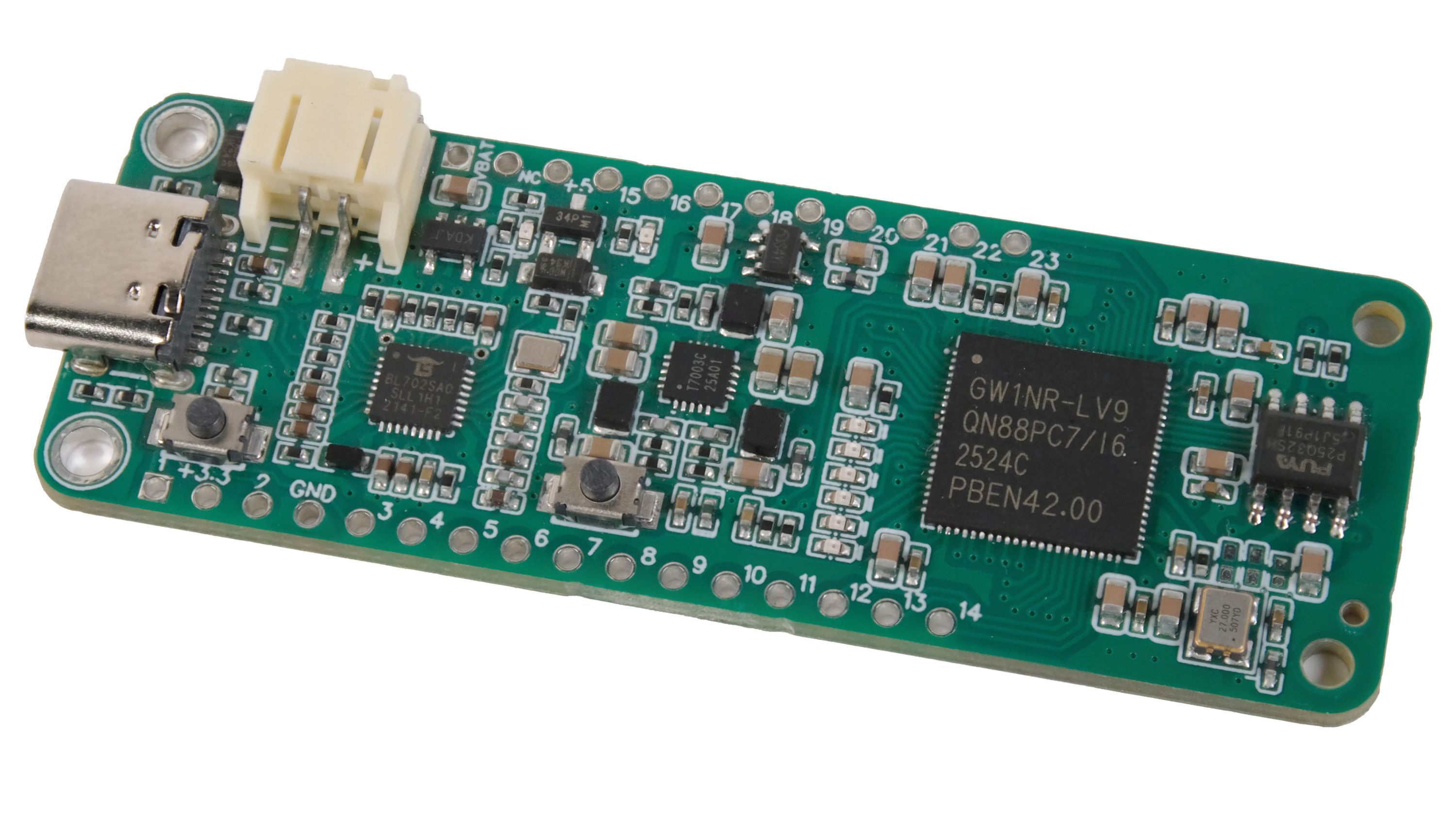
We are very excited to announce the launch of our crowdfunding campaign for ELM11 Feather, a Lua-programmable microcontroller board in the Feather form factor. Head over to our campaign page to secure yours! We are also excited to share an update on the product developments we’ve made since the pre-launch campaign began, so please read on…
Full-Stack Programmability
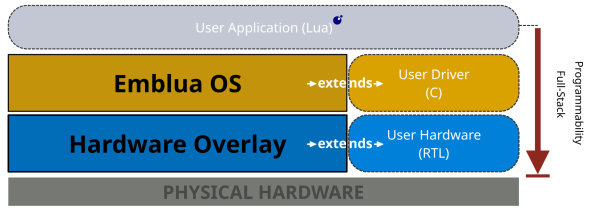
As promised, we have open-sourced the API for the driver and hardware layers. This has resulted in a product that is now full-stack programmable. You can now develop at the application layer (in Lua), at the driver layer (in C), and at the hardware layer (in VHDL or SystemVerilog). And you can do so at essentially the same time!
This opens up new realms of product development:
- Application Layer: In addition to permitting experimentation by offering a REPL, from a program point of view, this layer will host any high-level 'business logic' that the product implements. Think monitoring a UART data stream for a particular character and toggling the state of an LED, polling a temperature sensor and triggering the state of an actuator via GPIO, or offloading a mathematical calculation to the Driver Layer. The simplicity of Lua scripting will enhance user productivity, make code more succinct, and reduce the proliferation of bugs by, for example, removing the need for memory management.
- Driver Layer: Allows for processing that requires performance that cannot be achieved at the application layer. Think mathematical operations, signal and packet processing, binary operations, and perhaps fast I/O. Procedural C allows more advanced users to achieve functionality not possible at the Application Layer alone, but comes at the cost of greater coding complexity: static typing, pointers, memory management, etc.
- Hardware Layer: In addition to hosting any processing that requires even greater performance (such as mathematical operations and signal processing), this layer can host functionality that is only possible in hardware. Imagine, for example, a hardware-based watchdog that triggers a power cycle unless it receives a message from the application layer (via the driver layer). If implemented in hardware, this is a bullet-proof way to prevent a device from "bricking" itself indefinitely. Other examples might include protocols such as 1588-PTP that require hardware-accurate timestamping or custom, CMOS-level signaling used to interface with a particular device (such as a motor via quadrature encoding).
Arvore IDE
It is with great pride that we are also introducing the Arvore IDE!
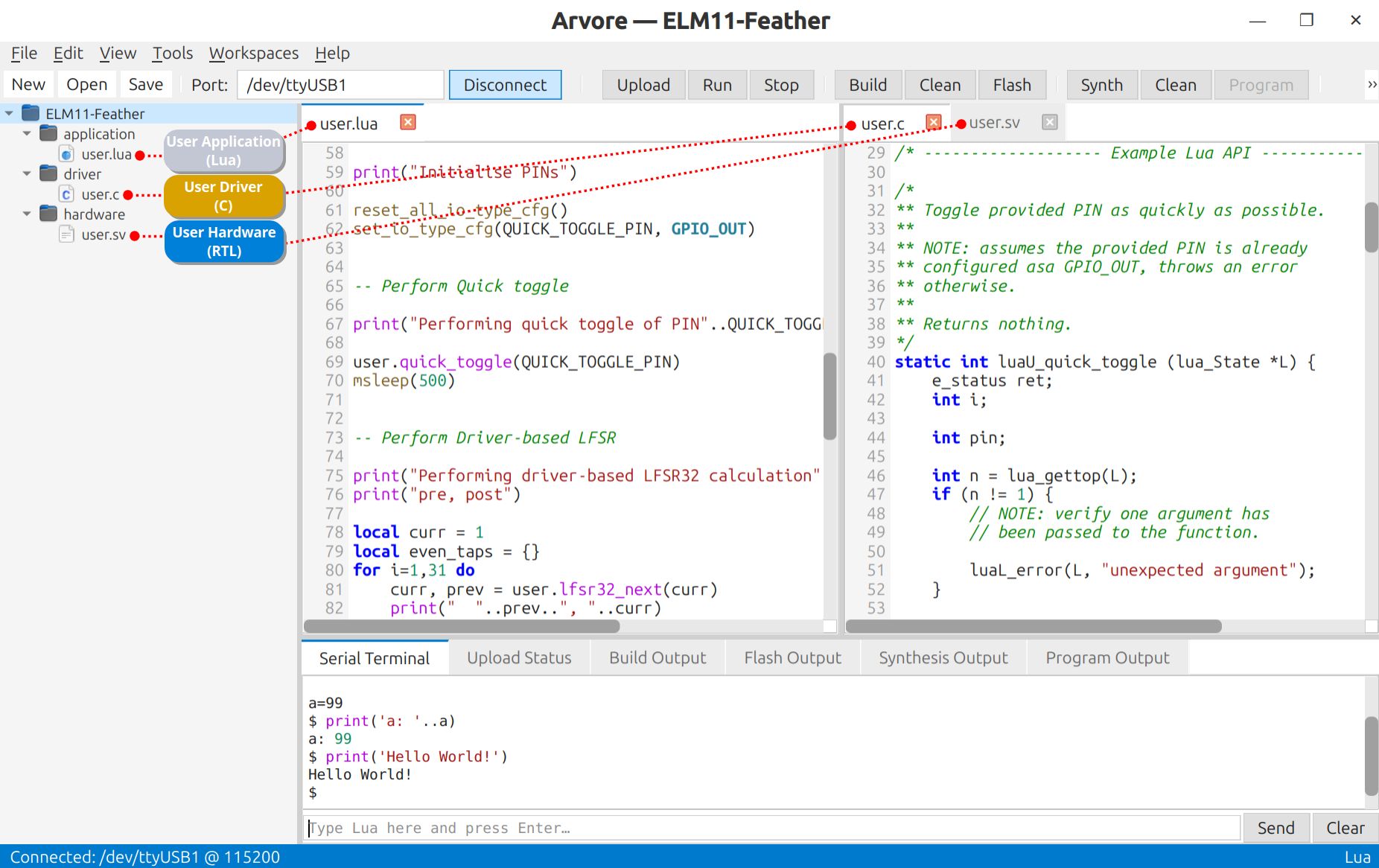
The Arvore IDE is packed full of unique features, but the most important is the unification of the three programming layers—their development and their deployment—into a single ecosystem. This massively simplifies your workflow and makes it easy to begin developing for the driver and hardware layers. No complex build scripts, interface definitions, and other plumbing required. You can simply create a new project, and each layer will have the ability to interface with adjacent layers. Then you can build it and flash it to ELM11 Feather:
Order Yours!
Head over to our campaign page to check out all the new features included as part of the ELM11-Feather ecosystem. We’d like to extend a big thank you to all of our supporters. If you feel this campaign is helpful, please share it with your family, friends, and professional networks!
Interested in Reviewing?
If you’re interested in reviewing ELM11 Feather, pleaes reach out to sales@brisbanesilicon.com.au.