Project update 3 of 8
A Closer Look at Pipo Analog
by Rupert RDear Subscribers,
Today, I’d like to tell you about some of the design choices behind Pipo Analog, one of the main boards in our crowdfunding campaign.
Board Connectors
The proposed connector choice, which might look uncommon to some of you, results from many trials and iterations and is meant to connect peripherals to Pipo in many different use cases. From prototyping or desktop work, to being fixed behind a multimedia installation or embedded in objects or costumes, the connection is meant to be as easy and reliable as possible.
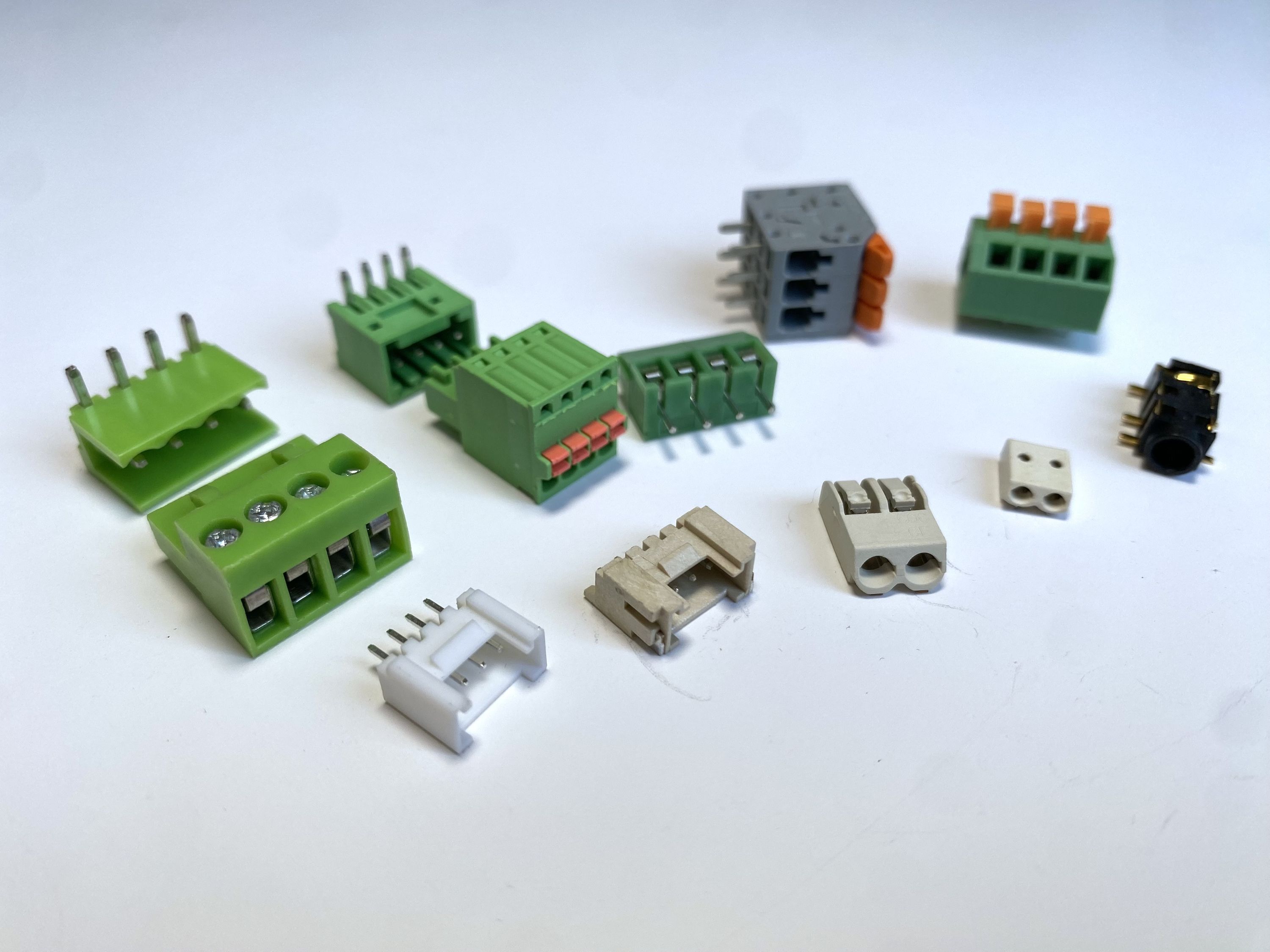
The "Grove" Connector (Voltage Inputs)
While this format is not exactly a newcomer in the maker world or at your local fablab, this connector is still a somewhat recent standard you might not have heard of. It has spread quickly and now most input modules or sensors are easily available using this format, slowly taking over modules without connectors.
Indeed, when you want to wire a potentiometer, a button, or an analog sensor, most input modules in the Arduino and maker world will require three to four wires: GND, V+ and one or two signals. Obviously using a connector is much more convenient than individual wires. I tested many other types of quick release and detachable connectors and confirmed the Grove connectors are the best match for Pipo. Far better, in most use cases, than headers or screw terminals.
Wiring is straightforward, the connection is reliable, and the flat SMD connector used on Pipo allows the board to keep a low profile for tight spaces. No need to fiddle anymore with loose jumper wires or tedious solder joints. The only minor drawback for beginners is that Grove connectors are used both by digital modules (I2S) and analog ones, which can be confusing when time comes to choose a module. (As of now, Pipo Analog has only capability for analog inputs, not digital. If you have questions about what can be compatible, don’t hesitate to ask us using this form, or in the Discord.)
The Push-In Wire Terminal (Touch Inputs)
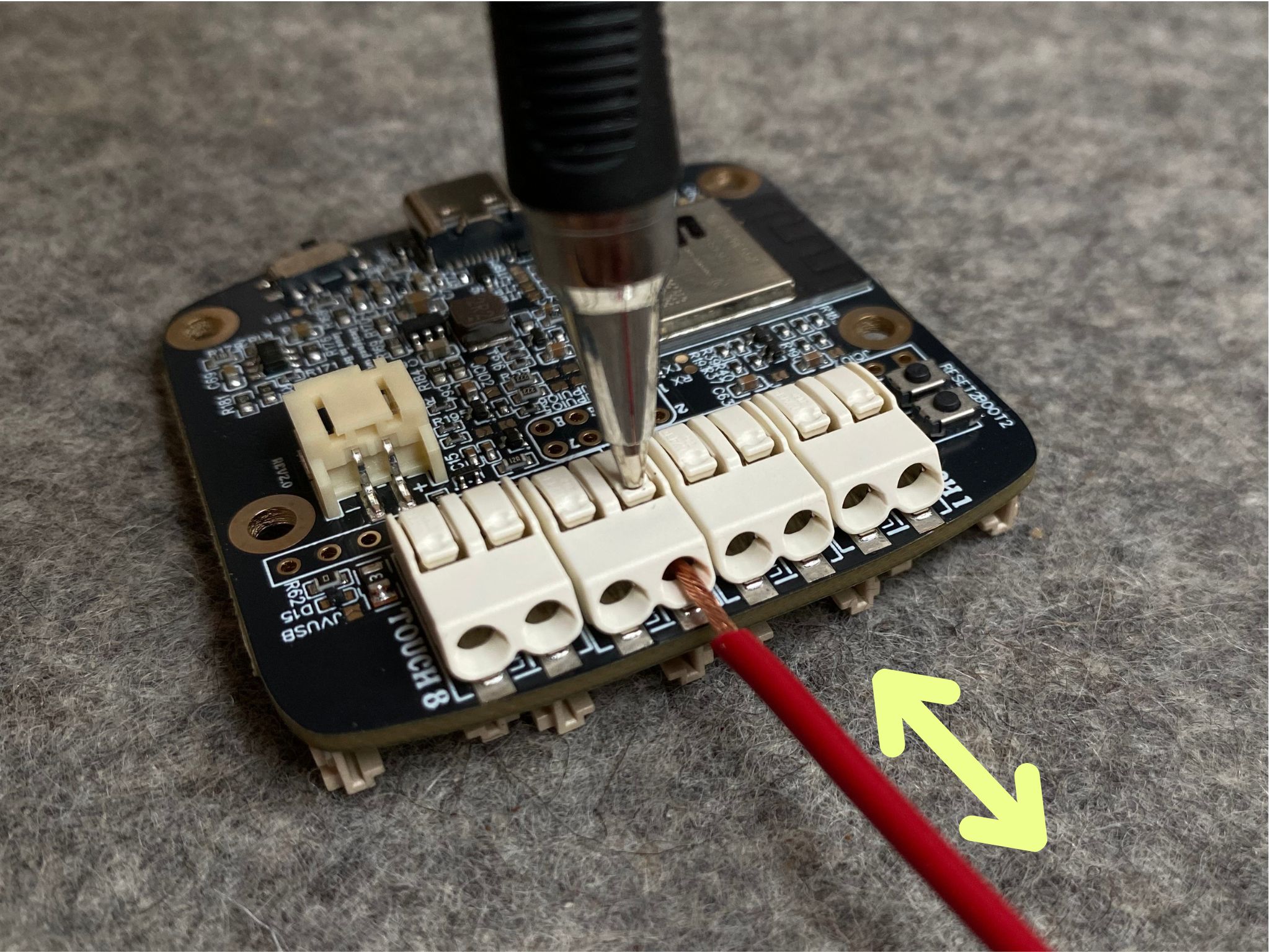
Unlike the voltage inputs, capacitive touch requires individual inputs. These push-in connectors offer a good balance between compactness, ease of use, and a good wire grip. Simply push on top of it (e.g., with the tip of a pen) to insert or remove a wire. Other brands of projects use alligator clips for similar use cases, but to me these quickly become impractical as soon as your project leaves your desk, as they are very unstable and take up lots of space.
Breakout Boards
For prototyping quickly with "non-Grove" modules, adapters from Grove cables to screw terminals are provided with Pipo Analog. That way, you can connect easily to whatever you already have at hand.
Input Solder Pads
Some of you will prefer to solder their connections or use headers. Pipo Analog has you covered! There are solder pads matching every connector lead on the board and they all use standard header pitch, so you can easily solder your cables directly or add a header at your convenience.
Input Protection
Frying a development board when prototyping is something that can happen. To lower this possibility, many protections have been implemented with Pipo Analog. Inputs are ruggedized to help protect against common manipulation mistakes. There are current limiting resistors as well as over-voltage and reverse protection diodes on the voltage inputs. There are also thermal fuse and diode protections on the power rails of the grove connectors power supplies. This should cover most of potential mistakes.
A Word on Upcoming Features
For now the current software of Pipo Analog only deals with conventional analog voltage input, like buttons, potentiometer, or analog sensor data, etc. There are still many additional ways to use these inputs which are on the roadmap (e.g., decoding encoders, driving simple ultrasonic sensors, pulse counting, and more…). In addition, input pre-processing is planned that will offer more options (such as logarithmic scaling and quantization).
The hardware is not designed for data like I2C or fast switching signals (this will be for another board),
Some of you might be looking for the HID mode (keyboard/mouse), which was initially mentioned in the pre-launch page. While it is not completely removed, a lack of demand and interest made me de-prioritize its features. Keyboard mode is still alive as an experimental mode until further notice. Let me know if these are important features to you.
As you can see, many new features are already are on their way, and I’m working to develop them as fast as I can!
Meanwhile, here is a quick demo of how to quickly set up a few Pipo Analog inputs.
Have a good week, and don’t forget to spread the word about Pipo and reserve yours today, we still need more support to reach our funding goal!