April 30, 2026
Whether you’re a consumer or a producer of goods, tariffs will almost certainly affect the availability and pricing of those goods, either directly or indirectly. Crowd Supply offers project creators several mechanisms for handling tariffs, all geared toward making it as easy and inexpensive as possible for both creators and backers.
One Warehouse, Worldwide Distribution
As a division of Mouser Electronics, Crowd Supply uses Mouser’s global distribution system to deliver Crowd Supply’s amazing products to happy customers all over the world. It’s hard to beat Mouser’s combination of voluminous warehouse space (1.5 million square feet), state-of-the-art automation (you’ve never seen so many conveyor belts), deep relationships with freight carriers (every major carrier has a dedicated office inside the warehouse), cutting-edge compliance (EU customs clearance and VAT are fast and painless), and global footprint (28 locations, 23 languages, and 34 currencies).
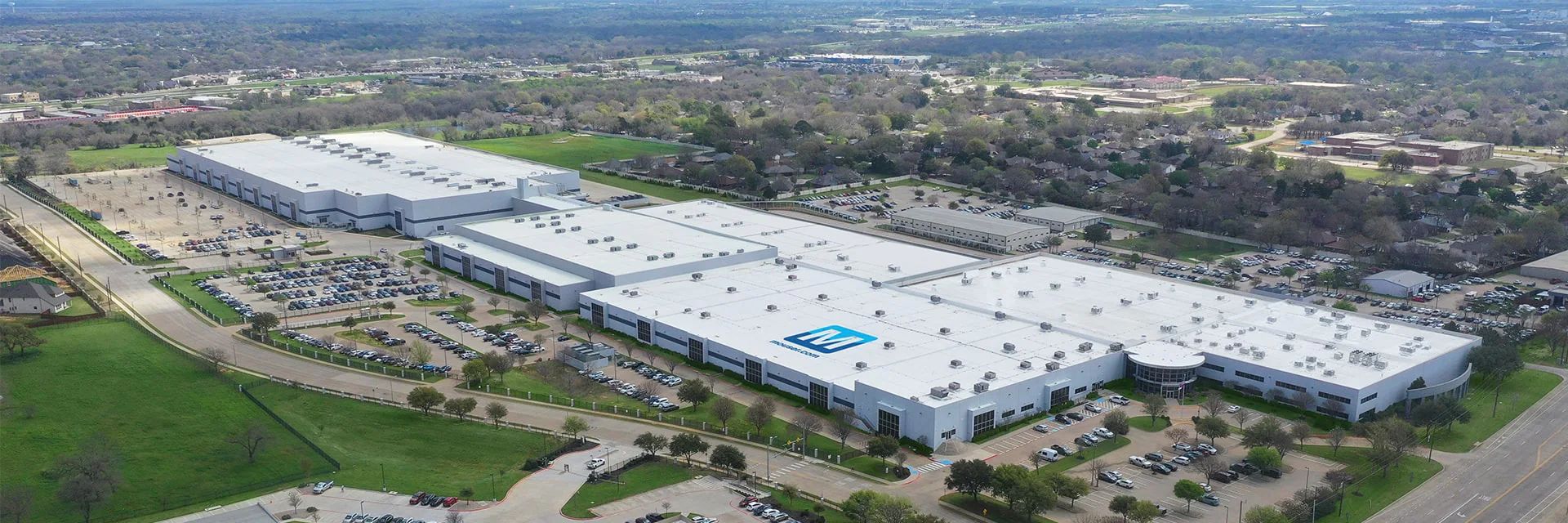
Mouser’s entire logistics system, built up and refined over the course of more than 60 years, is centered on its single warehouse near the Dallas-Fort Worth airport (DFW) in Texas. Every package is shipped from this facility, which means all inventory must first enter this warehouse. At the scale Mouser operates, this centralized approach is arguably the most efficient. In contrast, maintaining multiple warehouses or splitting logistics between multiple parties introduces costly complexity and brittleness around taxes, carrier rates, inventory management, export compliance, returns, customer support, etc.
The Power of Distribution
Centrally distributing products through Crowd Supply and Mouser makes handling tariffs easy and inexpensive for both customers and creators. Whether Mouser or the creator is handling import (both are options – see below for details), importing products into the US in a single bulk shipment removes the burden of import from the customer which is higly preferable for two reasons. First, shipping directly to customers means the tariff the customer must pay is based on the full retail price they paid rather than the wholesale price. Second, offloading import and tariffs to customers burdens them with significant service charges imposed by the carrier for handling customs clearance and tariff remittance.
Tariffs aside, distributing products through Crowd Supply and Mouser has many other advantages, such as:
- Taxes: We collect and remit tax for many regions, including VAT for all EU countries. Many of our customers already have their VAT ID associated with their accounts, in which case we don't charge them VAT. The amount of VAT remitted is based on the ship date, not the date of sale, which can be quite different in the case of crowdfunding campaigns.
- Export Compliance: We handle export compliance for every order. Many products, especially those using modern wireless chipsets and processors, fall under very specific export and import regulations that could result in very heavy fines or criminal charges if not carefully adhered to.
- Undelivered, Damaged, and Returned Packages: A lot can go wrong with a customer package, and fixing those problems is much easier with integrated shipping, order, and customer support systems, as well as close ties with the shipping carriers.
- Crowd Supply House Order: Crowd Supply (and Mouser) will likely put in a relatively large house order on top of what backers order so we can continue selling the products after the campaign. Since our house order will need to be shipped to us anyway, there is a cost savings in bundling everything together and reducing the total number of shipments.
Import & Tariff Mitigations
Critical to Mouser’s logistic system is the proper and smooth handling of import and tariffs. To that end, Mouser supports the following mitigations:
- Drawback Program: For products Mouser imports from outside the US that are then shipped to customers outside the US, Mouser draws back tariffs from the US government. This is an automated process invisible to both the customer and manufacturer.
- Foreign Trade Zone: Mouser's warehouse is a foreign trade zone (FTZ) capable of bringing products from outside the US without actually importing them or paying tariffs until the products leave the warehouse when shipped to customers. This means tariffs are never paid (and there is no need to draw them back) for orders destined for outside the US. Because the FTZ is so heavily regulated, it takes considerable effort and expense to set up a Mouser supplier to use the FTZ, which means it is generally used only for suppliers with a consistently large sales volume.
- Separate Tariff Charge: Some products incorporate tariffs into their base prices. Mouser also supports the option of charging separately for tariff based on the origin of the product and the location of the customer. This is something Crowd Supply has started to do in certain cases.
- Import Options: Mouser is fully equipped to completely handle all aspects of importing products into the US, including paying tariffs. At the same time, Mouser can also work with manufacturers who want to handle that themselves. Both of these options are available to Crowd Supply creators. More on this below.
- Free Worldwide Shipping: For certain products, free worldwide shipping can be economically viable. Tariffs essentially make what would otherwise be a domestic shipment more expensive for US customers, thereby leveling the cost of shipping an order, regardless of destination country.
The Jargon of Logistics
To understand the effect of tariffs on Crowd Supply projects, and how we mitigate those effects, it helps to understand the terms defined below: country of origin, importer of record, declared value, and incoterms.
Country of Origin (COO)
A product’s country of origin (COO) is the country designated by the manufacturer of the product indicating where that product was made. In some cases, this is an easy question to answer. For example, a product that consists solely of a printed circuit board (PCB) with electronic components on it would typically have a country of origin of wherever the board and components were assembled into a single, working product, regardless of the countries of origin of the constituent components and PCB. Other cases can be more complex. For example, what is the COO for product consisting of a PCB assembly from one country and a power supply, fan, and enclosure from a second country, all assembled, programmed, tuned, and tested in yet a third country?
The primary framework for answering such questions is known as substantial transformation. Different countries have different rules governing when a product can be considered made in that country. For example, Canada requires at least 50% of the value of the product to be added in Canada for the manufacturer to declare a COO of Canada. It is up to the manufacturer of the product to determine the correct COO and to back up that claim with supporting evidence if so asked by a customs agent or trade partner.
Importer of Record
A product’s importer of record is the legal entity responsible for complying with all regulations associated with bringing the product into a country. This includes paying tariffs, providing customs officials with documentation, and attesting to how the product is classified, including its country of origin and various tariff codes, such as HTSUS.
Some companies are their own importer of record. Others might hire a professional third-party to be the importer of record. As a division of Mouser Electronics, Crowd Supply uses UPS Supply Chain Services as the importer of record whenever Crowd Supply has responsibility for importing products from outside the US.
Declared Value
When importing a product, the importer of record must declare to customs the financial value of the product, known as the declared value. If the importer is (or is working on behalf of) the buyer of the product, then the declared value is the amount the buyer paid to the seller of the product. If the importer is (or is working on behalf of) the manufacturer of the product, the declared value is typically either the amount paid by the buyer, or the amount that it cost the manufacturer to create the product, which is typically less than the amount paid by the buyer. The difference is the manufacturer’s gross margin on the product.
The tariffs paid on a product are based on the declared value. For example, a 15% US tariff on products made in Germany means that the importer of record would be responsible for paying a tariff of $15.00 to the US government to import into the US a product with a COO of Germany and a declared value of $100.00. As with everything, customs officials may ask for proof of the declared value, such as a commercial invoice.
Incoterms
International commercial terms, or incoterms, specify the division of responsibilities between a buyer and a seller for getting a product from the seller to the buyer. Such responsibilities include freight costs, insurance, export, import (including tariffs), pickup and delivery locations, and (sometimes) mode of transport. Incoterms are typically represented as one of eleven three-letter abbreviations in conjunction with a named location. The three-letter abbreviation stipulates who has responsibility for what, and the named location stipulates either the pickup or delivery location, depending on the context.
For example, DDP stands for delivered duties paid and means the seller is fully responsible for every aspect of delivering the product to the buyer. In the case of Crowd Supply purchasing products (from anywhere in the world) to be delivered to Mouser’s warehouse in Texas, with the responsibility for delivery being fully on the manufacturer, the fully specified incoterm would be DDP Mansfield, Texas, USA.
Another common incoterm is EXW, which stands for ex works and is essentially the opposite of DDP in that all risk is carried by the buyer. In the case of Crowd Supply purchasing products from a manufacturer in Shenzhen to be delivered to Mouser’s warehouse in Texas (or anywhere else in the world), with Crowd Supply taking on all the associated risks, the fully specified incoterm would be EXW Shenzhen, China.
Another incoterm is FCA, which stands for free carrier and is similar to EXW except that the seller is responsible for clearing the product for export – the buyer is responsible for freight, insurance, and import, including tariffs. Depending on the jurisdiction, clearing a product for export may be as simple as having a business license. In the case of Crowd Supply purchasing products from a manufacturer in Shenzhen to be delivered to Mouser’s warehouse in Texas (or anywhere else in the world), with Crowd Supply taking responsibility for everything except export, the fully specified incoterm would be FCA Shenzhen, China.
A Choice for Project Creators
In addition to the fundamental decisions about where products are made and by whom, project creators also choose how products are shipped to Mouser’s warehouse for further distribution to customers. Concretely, the choice is between DDP and FCA incoterms:
| DDP US Incoterms | FCA non-US Incoterms | |
|---|---|---|
| Importer of record | Not Crowd Supply | Crowd Supply |
| Declared value | COGS or PO value | Value of purchase order |
| Tariffs | Paid by creator | Paid by Crowd Supply |
| Tariff drawback | None | For orders outside the US |
| Freight | Paid by creator | Paid by Crowd Supply |
| Insurance | Paid by creator | Paid by Crowd Supply |
| Brokerage fee | Paid by creator | Paid by Crowd Supply |
| Export from non-US | Arranged by creator | Arranged by creator |
Choosing the right option for a given Crowd Supply project is very important, but one option is not inherently better than another – the optimal solution depends on the exact situation. Below are some example scenarios and the respective fees Crowd Supply charges. The crowdfunding fee is the percentage of gross sales Crowd Supply keeps of the initial crowdfunding campaign. The item fee is the flat fee Crowd Supply charges for each item shipped as part of the initial crowdfunding campaign - it covers costs like packaging, warehouse labor, and customer support. Below are some example fees for various combinations of incoterms and country of origin (and accompanying tariffs):
| Incoterms | COO | Example crowdfunding fee | Example item fee |
|---|---|---|---|
| DDP USA | anywhere | 12.00% | $5.00 |
| FCA USA | anywhere | 12.00% | $6.00 |
| FCA Germany | Germany (~15% tariff) | 22.00% | $7.00 |
| FCA China | China (~35% tariff) | 32.00% | $7.00 |
| FCA Germany | China (~35% tariff) | 32.00% | $7.00 |
Though the above fees are typical, they can vary based on a number of factors, such as the current or expected tariff rate for a particular country, freight prices, and whether backers get free shipping.
The many ways of getting things from point A to point B are constantly shifting due to changes in trade policy, component sourcing, manufacturing capacity, freight routes, regulatory compliance, and countless other factors. Crowd Supply aims to help project creators navigate these complexities and find a suitable solution for each project, with a focus on simplicity and risk minimization. Learn more about launching a project on Crowd Supply.