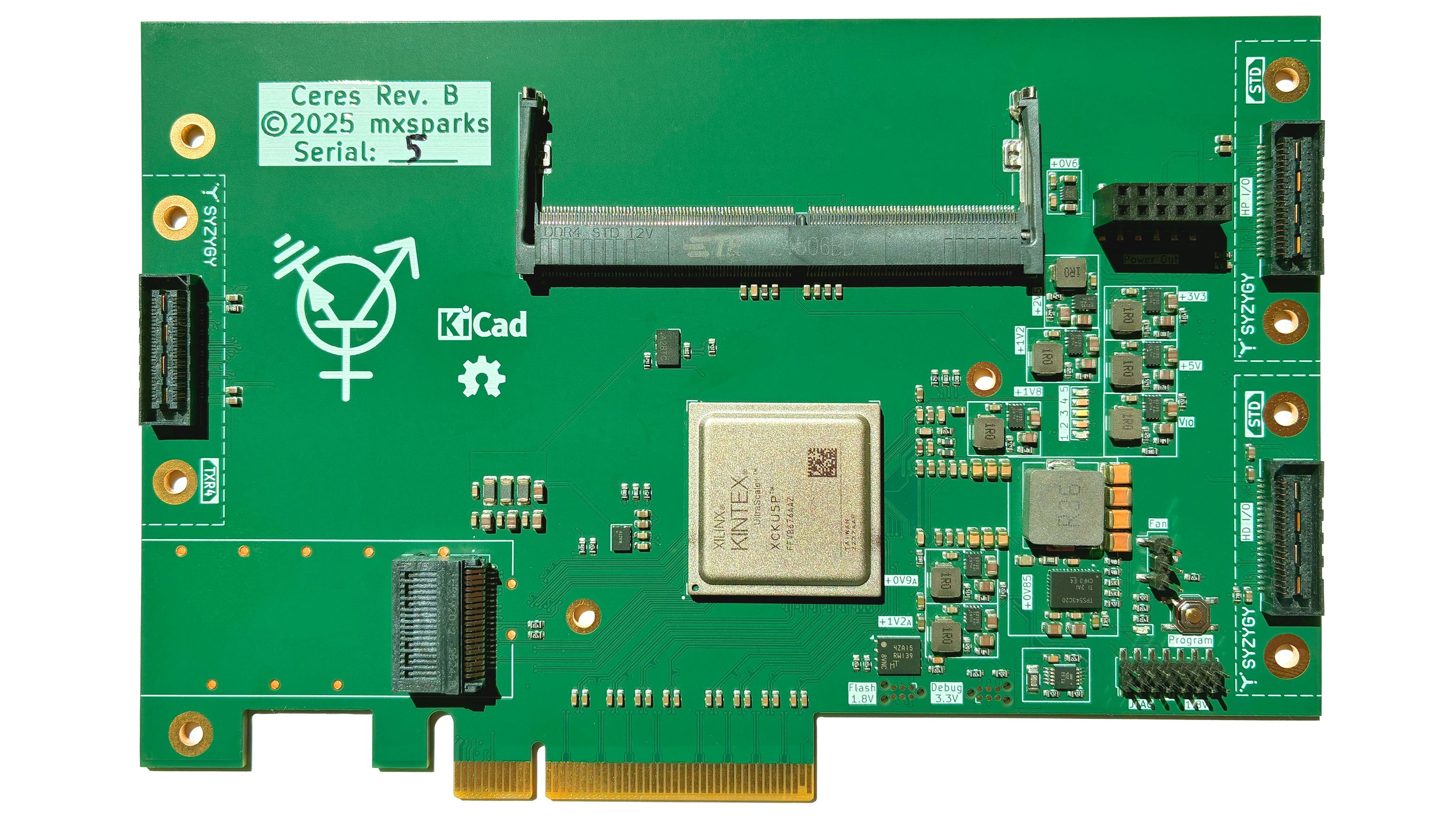
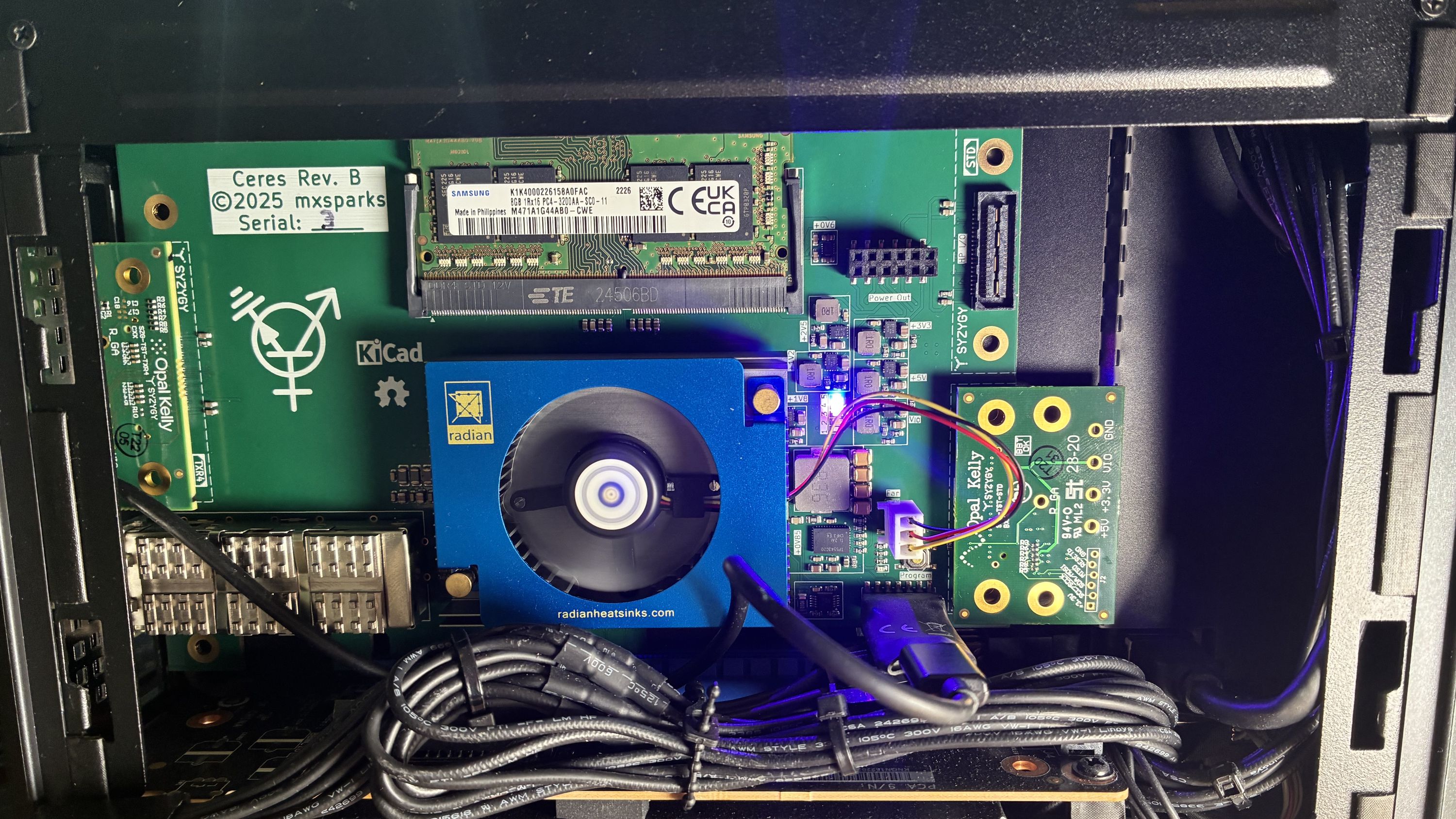
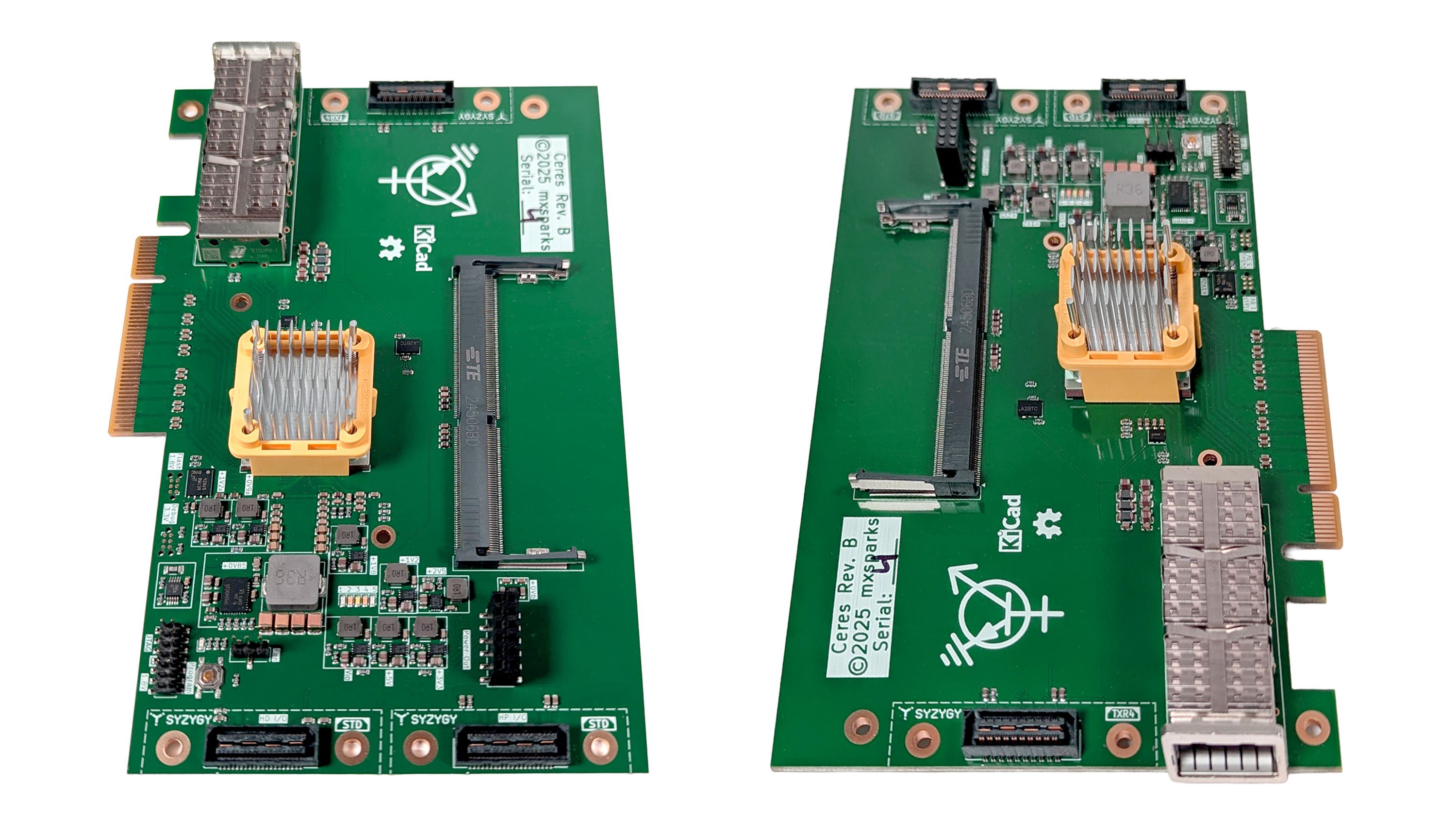
Ceres is an FPGA development board built around the biggest and fastest FPGA available that doesn’t require a paid EDA tool license. It plugs into a PCIe Gen3 x8 slot, accepts up to 32 GB of DDR4 memory, and features a versatile AMD Kintex™ UltraScale+™ FPGA chip at its heart.
It is engineered to expose as much I/O to the user as possible through its array of QSFP28, SYZYGY TXR4, and SYZYGY STD ports. Ceres is a single board that can handle a wide range of high-bandwidth scenarios, including 100 Gigabit Ethernet or DisplayPort 2.1. Its robust power delivery system lets Ceres handle almost any soft processor design.
Ceres has a robust, performant design that makes it great for tasks like machine learning inference, high-speed networking, data acquisition, video processing, and computer architecture research.
Eight serial transceivers with up to 28 Gbps each are exposed through a QSFP28 cage and a SYZYGY TXR4 port. They accept commercially available 100 Gigabit Ethernet QSF28 modules and SYZYGY transceiver pods, and allow experimenting with high-speed transceiver pods of your own design.
Two SYZYGY STD ports make Ceres compatible with a wide range of existing peripherals, including Avnet’s line of high-bandwidth ADC and DAC Zmods.
Features & Specifications
I/O
- PCI Express Gen3 x8 edge connector (potentially Gen4 capable with custom IP)
- 260-pin SODIMM slot for up to 16 GB DDR4-2400 or 32 GB DDR4-2133 DRAM
- zQSFP+ (QSFP28) cage for up to 100 Gbps Ethernet
- SYZYGY TXR4 port with four 28 Gbps lanes and 14 high-density I/O
- SYZYGY STD port with 32 high-performance I/O as 16 differential pairs
- SYZYGY STD port with 32 high-density I/O
Programming and Debugging
- 128 Mbit QSPI Flash with Tag-Connect TC2030 programming header
- 14-pin JTAG header compatible with AMD and Digilent
- Debuggable over PCI Express using AMD Virtual Cable and Hardware ICAP
- Full-height, half-length PCI Express (111 x 168 mm, 4.3 x 6.6 in)
Open Source
Ceres is open-source hardware, released under the CERN-OHL-P-2.0 license. The hardware repository on SourceHut contains KiCad design files as well as schematics, board layout, BOM, as well as an XDC file with I/O constraints.
Open-source gateware and firmware for Ceres are available under the MIT License. The gateware repository on SourceHut contains projects with AMD Vivado™ development tools and AMD Vitis™ design suite for bringup testing and validation, and will eventually contain sample designs using LiteX and Amaranth.
Interested in This Project?
You can sign up at the top of this page to be notified when the campaign launches and to receive other updates. We only send out relevant content, and you can unsubscribe at any time.