Project update 1 of 1
Six Years in the Making, Open Book Touch Is Here!
by Joey CastilloHey y’all, Joey here. I feel a bit overwhelmed at sharing this today, for reasons that will become clear shortly, but the gist is this: the slim, pocketable, fully open source e-reader I’ve been chasing for six years is real, and as of today it’s live on Crowd Supply!
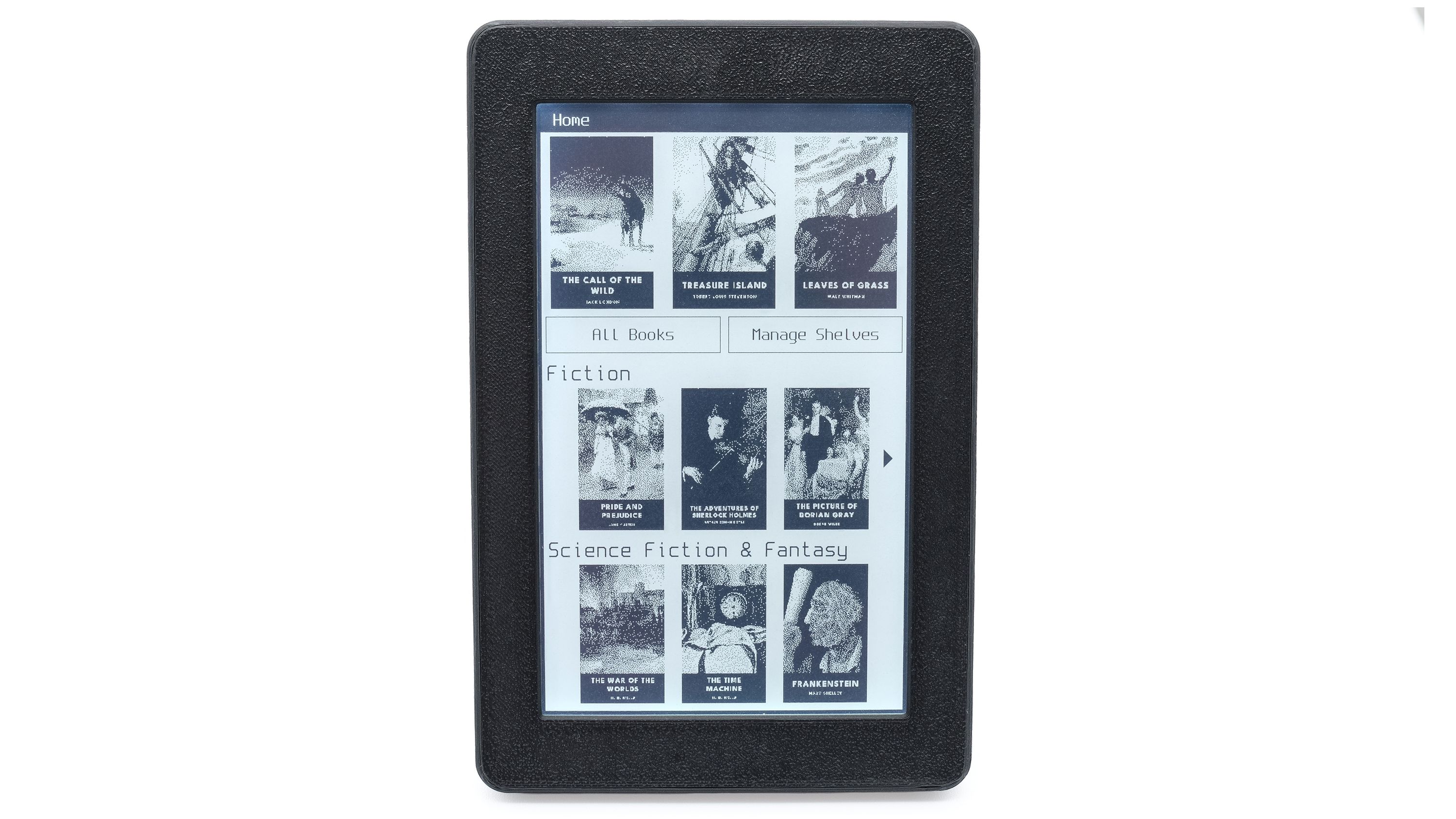
In a minute I’m going to show you the thing, and for the record: there’s a LOT to show. But it’s launch day, and launch day feels like the time to look back, and forward. In particular one question comes to mind: why have I spent six years of my life trying to build a book?
Why Build a Book?
Six years ago, I typed a sentence into a README file: "As a society, we need an open source device for reading." It was, in hindsight, cocky to both say that and suggest I was the one to deliver it. I was not an electrical engineer; my experience at the time consisted of soldering header pins poorly, and writing Arduino sketches for Adafruit Feather boards. In fact, the first mostly-integrated prototype of Open Book was called the "E-Book FeatherWing", a circuit board with a screen you could snap onto a dev board that I lacked the talent or know-how to design myself.
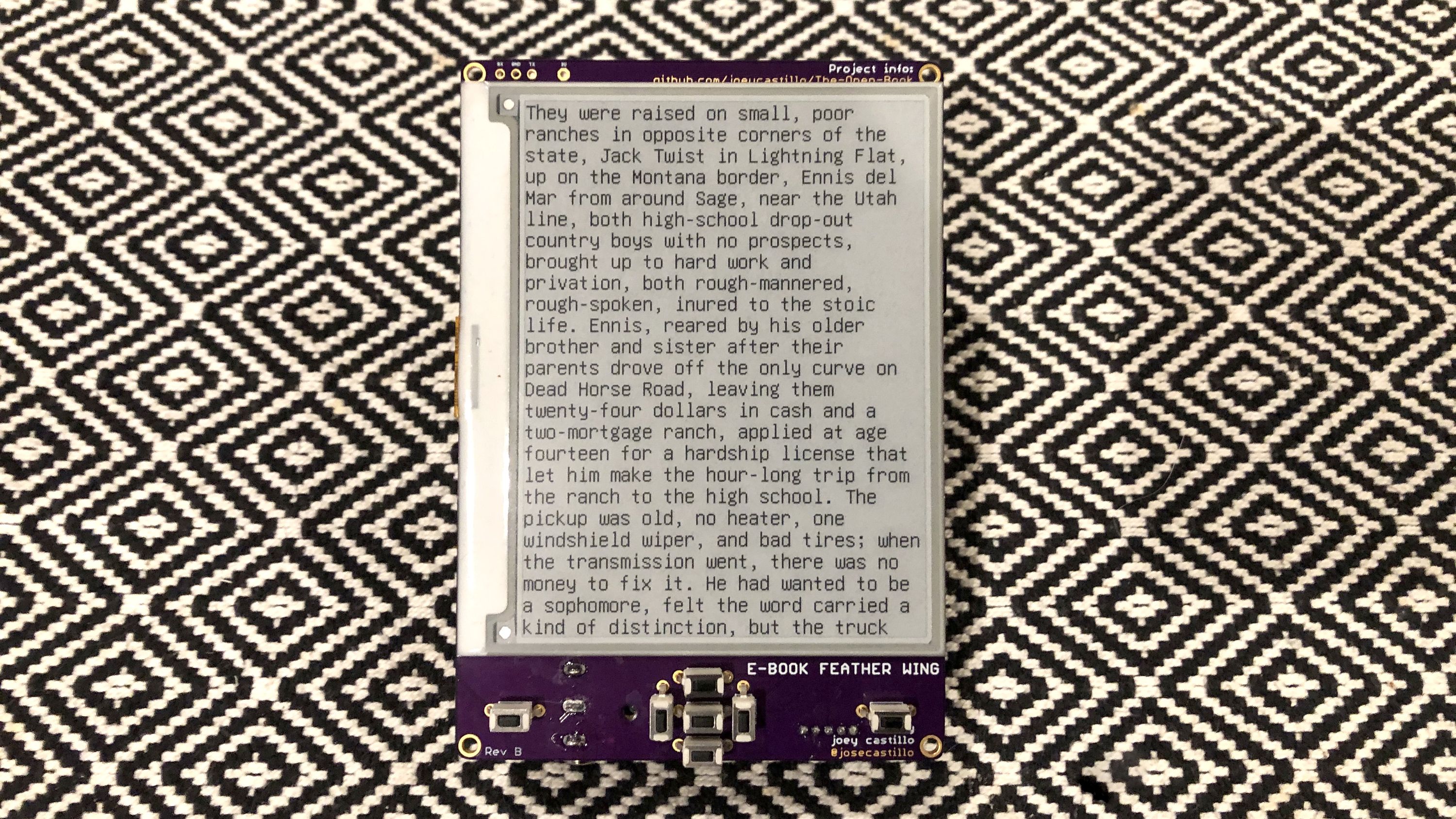
If you soldered that board together yourself, you’d end up with something that could run a single Arduino sketch to display a single book as a wall of plain text. "An open source device for reading", if you squinted a little. But I still believed in that sentence, even if I didn’t have the skills at the time to make it real. In the ensuing years I literally taught myself electrical engineering in order to build the Open Book — and Open Book Touch is the point in that journey where I’m ready to tell you it’s real.
The book stands as the most durable technology we have for sharing knowledge and understanding: a quintessential human invention that has carried everything we know across millennia. Literacy is arguably the original technology: fire kept us warm; the wheel helped us move; but words were the first thing that literally changed our minds. From Gilgamesh pressed into clay to the mass-market paperback, words moved ideas out of one mind and into another.
And for nearly all of that history, the objects that carried those words had a property so fundamental that nobody ever thought to name it: once a book was yours, it was yours. You could lend it, mark it up, give it away, lose it, find it, leave it behind for your grandchildren. Nobody could reach into your home and take a book off your shelf.
Then reading became a service, just like everything became a service. The most popular reading devices today aren’t tools for sharing knowledge but rather vehicles for capturing value: they require an account to be useful, they report your reading back to headquarters, they show you ads on the lock screen, and the books on them are revocable licenses, rented from a platform whose interests aren’t aligned with yours.
Open Book Touch is a different choice: a book that works for its reader, and answers to no one else. But if making good on the manifesto was all it took, that hand-soldered board from 2020 would have been enough. To make it real, I knew I had to deliver a cohesive product that you could live with and actually want to carry around and read on.
Open Book Touch is that naïve dream, all grown up.
The Part Where I Show You the Thing
The wall of plain text is replaced by a real typesetting engine rendering real EPUB files. When you open a book, it reads like a book. Lines can be set justified with even spacing or ragged right, and words are hyphenated where they should be.
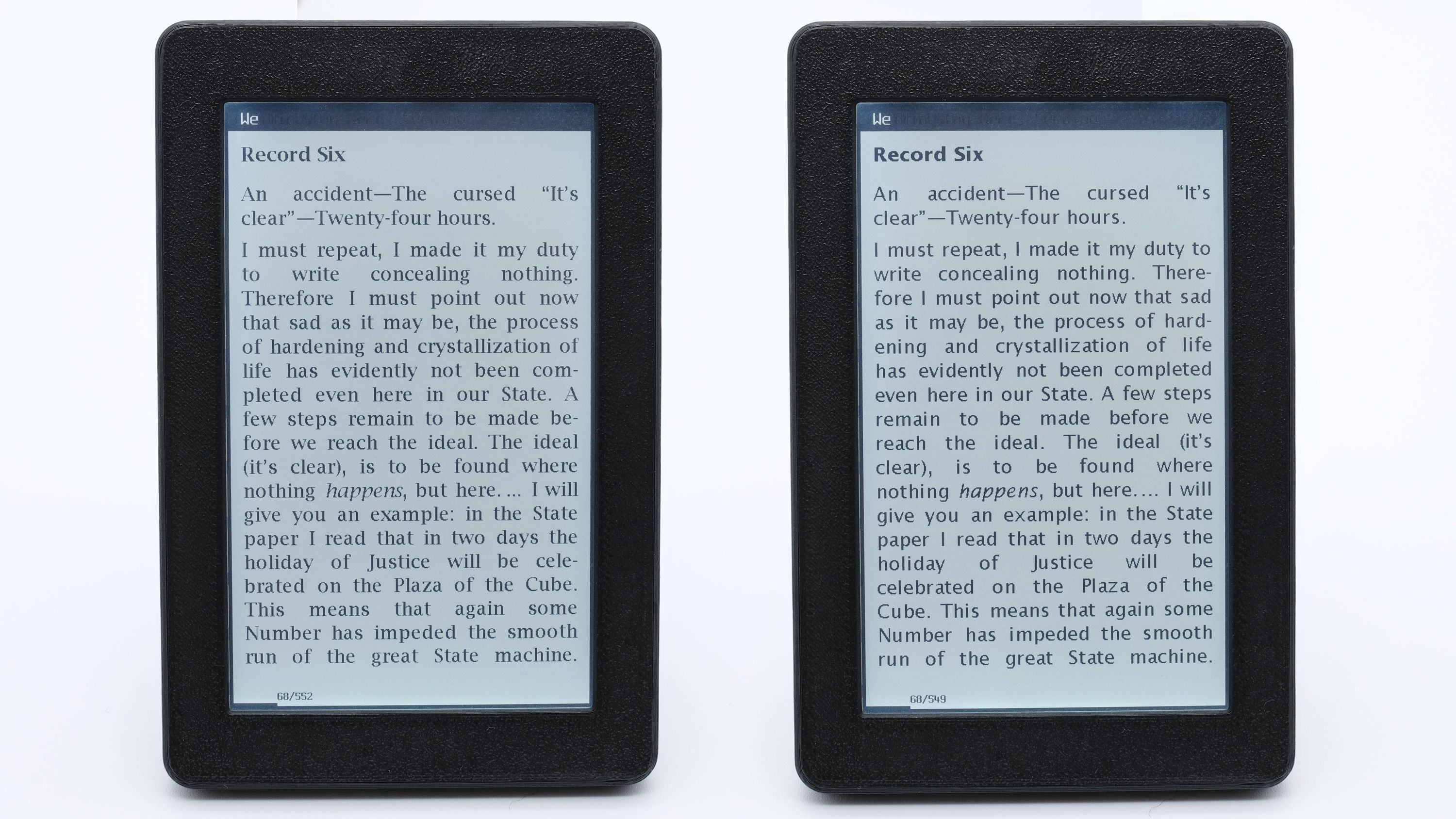
Your books are set in Lucida Bright (serif) or Lucida Sans: real, carefully drawn bitmap letterforms in three sizes, with true bold and italics actually drawn at every weight, not the synthetic slanted stuff that I used to try to get away with.
The bare board is now a finished object: a single, symmetrical 4.26-inch front-lit e-paper touchscreen, a centimeter thin in a 3D-printable enclosure, that slips into a pocket and disappears until you open it to read. And the dream of reading the whole world is real too — some 70,000 glyphs spanning the world’s writing systems, right-to-left scripts and all, ship on every device.
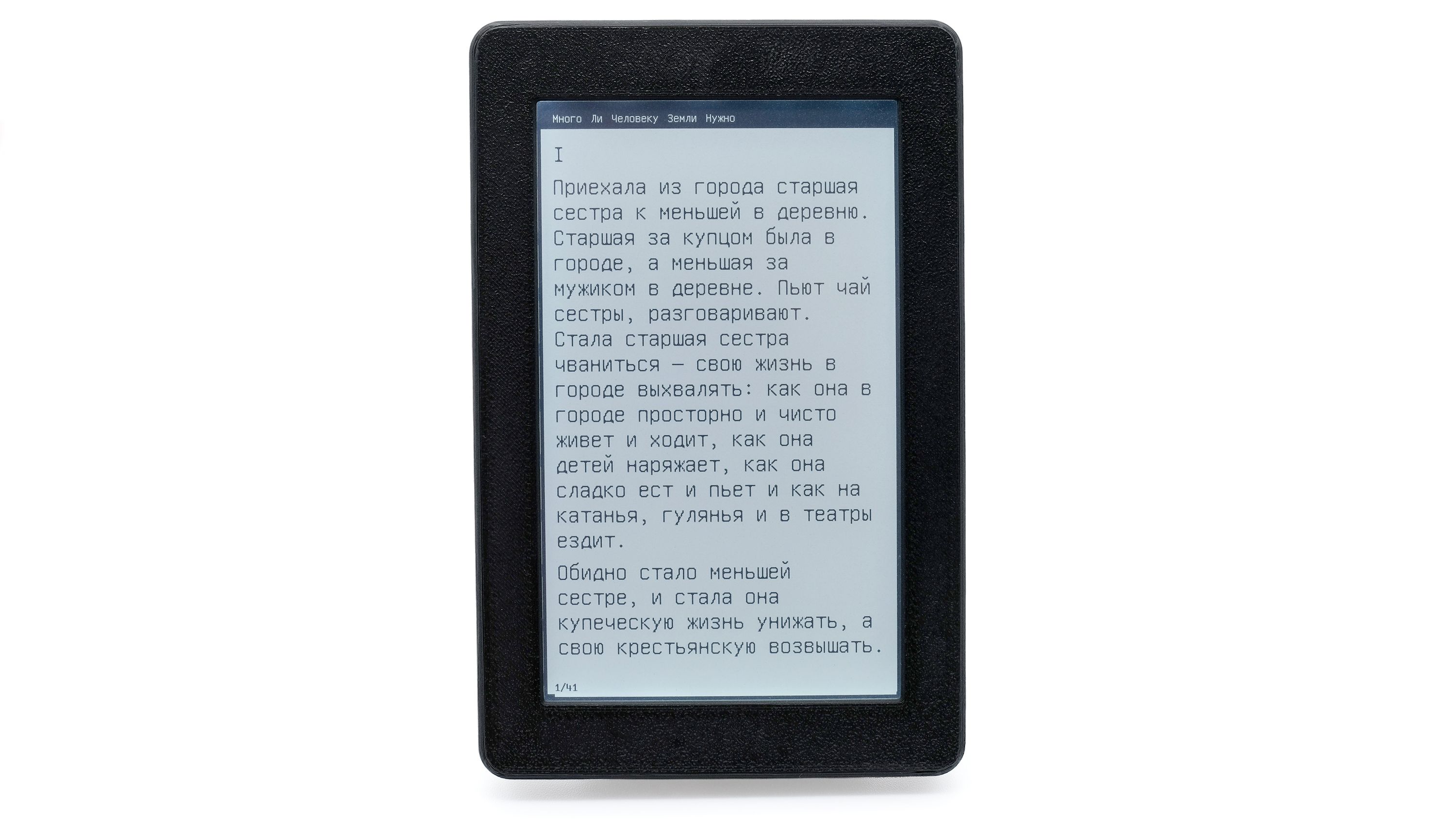
When the lights go down, the frontlight is the delight: warm and cool LEDs you can blend with a gesture. You just start in one of the corners and drag up for brighter, low for dimmer, left for warmer, right for cooler. Who wants a slider? You can slide your finger across the whole screen to warm it all the way down for reading in bed, cool it in daylight, and dial in any brightness in between, all without wrecking your night vision poking around in menus.
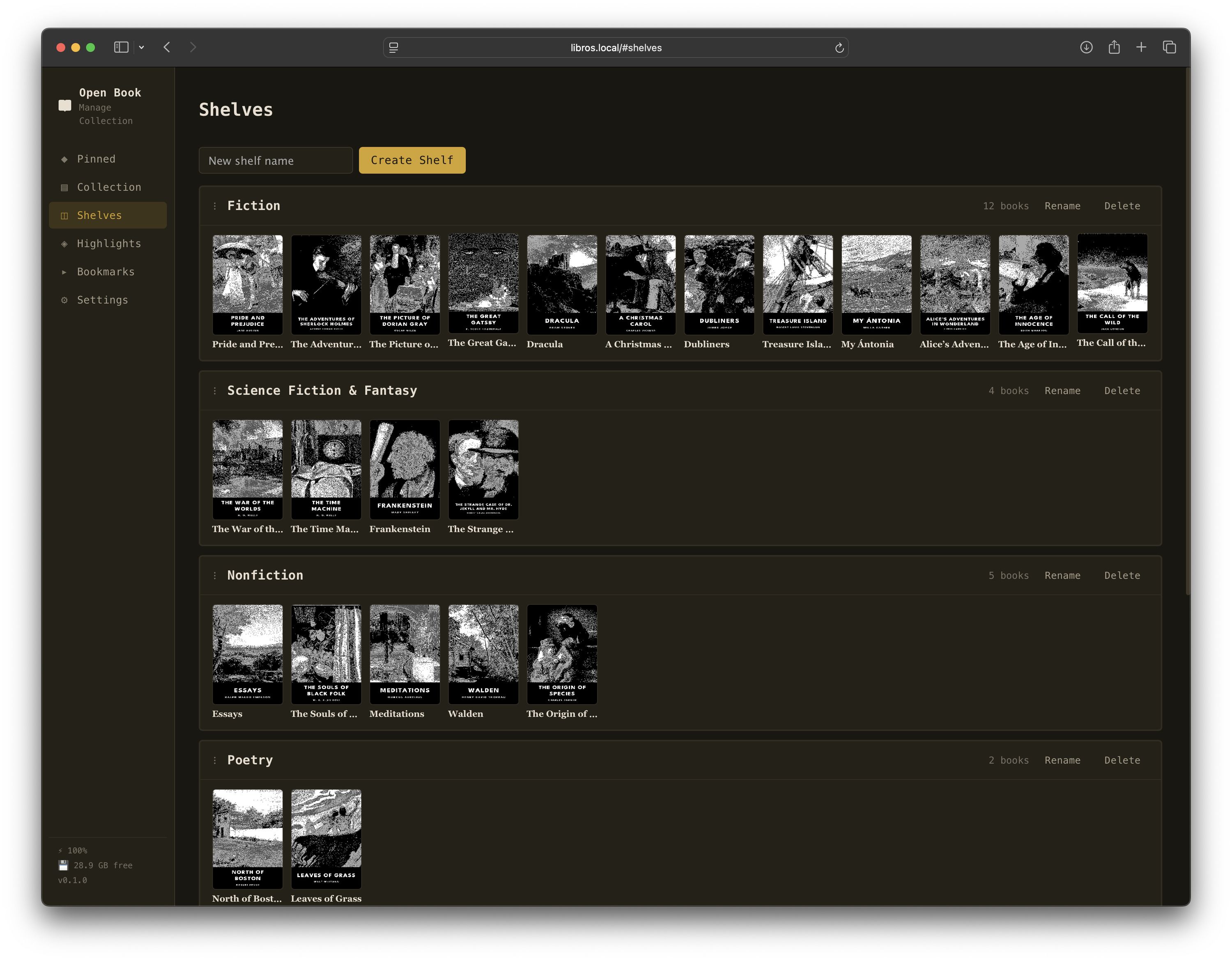
Drop an EPUB or a plain text file on the microSD card and it lands on your shelf — or skip the cable entirely and send books to Open Book Touch from your web browser over Wi-Fi. No account, no app, no cloud. On your home network, it’s just http://libros.local (we’ve named the firmware Libros, after the Spanish word for "books").
And it lasts. In our testing, you can expect about a week of reading per charge with the frontlight at a low setting, and over a month of standby. Put it down for a week, pick it up, and it opens to the exact spot on the page where you left off.
It’s Live — Here’s the Deal
The campaign is live today, with a funding goal of $45,000. That number is real. This isn’t a goal set low so we can declare victory no matter what; it’s the level of interest and support we need to make this economically viable. If enough of us want Open Book Touch, it happens. If not, it doesn’t.
There are two ways to back it:
- Open Book Touch — $149. The complete device: reader, frontlight, replaceable battery, 3D-printed enclosure (with an injection-molded enclosure as a stretch goal, if we can pull it off).
- Open Book Touch, Special Edition — $249. The same device, dressed up in premium materials and finish. The exact form is still taking shape, and I'm hoping to share a first look later in the campaign — but trust me when I say I want to make it something special.
If this is a thing you’ve been waiting for — and if you’ve read this far, I suspect it might be — back it today, and tell a friend who reads.
What’s Next
I’ll be posting a new update every Thursday for the duration of the campaign: the on-device niceties (bookmarks, highlights, dictionaries and search — yes, full-text search), the from-scratch UI framework underneath it all, reading in the world’s languages, making the enclosure your own, and even how you’ll write your own apps for it. Even if you don’t want the gadget, I hope you follow along just to hear tales of making this thing real.
And of course, because it’s the point of all this: Open Book Touch is open source hardware with MIT-licensed firmware, and every design file will go public when devices ship to the backers who made them possible.
Six years ago I wrote that we need an open source device for reading. Today, at long last, I get to hand it to you: a liberated book for the people.
Let’s do this.
— Joey