Hello HealthyPi 6 backers!
The HealthyPi 6 campaign has been a success! Thank you to everyone who has supported this project. The campaign is ending soon, and this is your last chance to grab campaign pricing. After the campaign closes, prices will increase slightly ($549 → $599), so now is the best time to back the project.
For this update, we want to showcase something we’ve been working hard on: real-time EEG acquisition and visualization. We’ll walk you through the HealthyLink EEG Module, the new EEG features in HealthyPi Studio, and a simple demonstration showing the system capturing real brain signals.
HealthyLink EEG Module
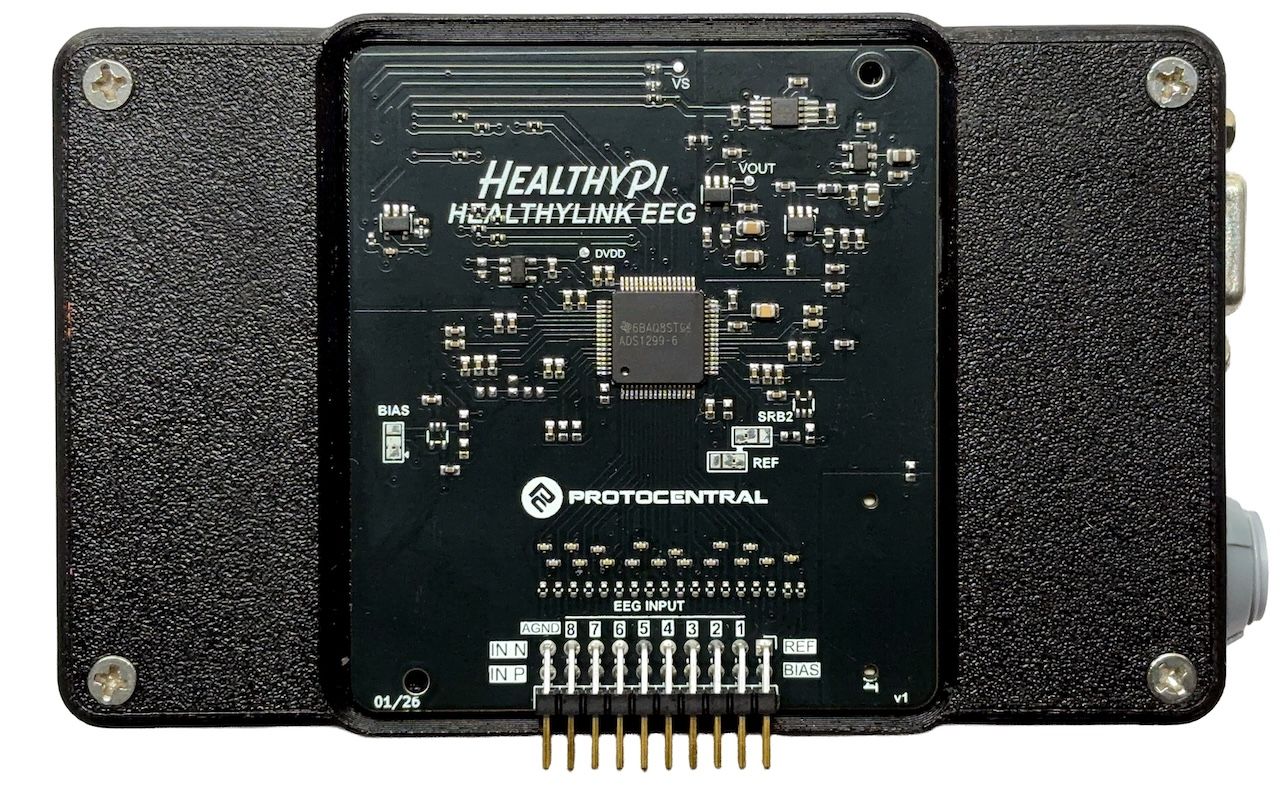
In the last update, we introduced the HealthyLink EEG Module, an 8-channel, 24-bit EEG acquisition board based on the Texas Instruments ADS1299. Here’s a quick recap of the specifications:
| Specification | Value |
|---|---|
| AFE | Texas Instruments ADS1299 |
| Channels | Eight differential inputs |
| Resolution | 24-bit |
| Sample Rate | 250 / 500 / 1000 / 2000 SPS |
| Input Noise | <1 µVpp |
| Interface | SPI via HealthyLink connector |
The ADS1299 is the same chip found in research-grade EEG systems costing a lot more. HealthyPi 6 with Healthylink EEG gives you access to the same level of signal quality in an open-source, affordable platform.
An added benefit: HealthyPi 6’s isolated USB connection, originally designed for patient safety, also significantly reduces 50/60 Hz power line noise that plagues many EEG setups. You’ll enjoy clean signals without the usual ground loop headaches.
HealthyPi Studio: New EEG Module
We’ve been actively developing HealthyPi Studio, our cross-platform desktop application built with Flutter. The latest version includes a dedicated EEG module for visualizing and analyzing brain signals in real-time.
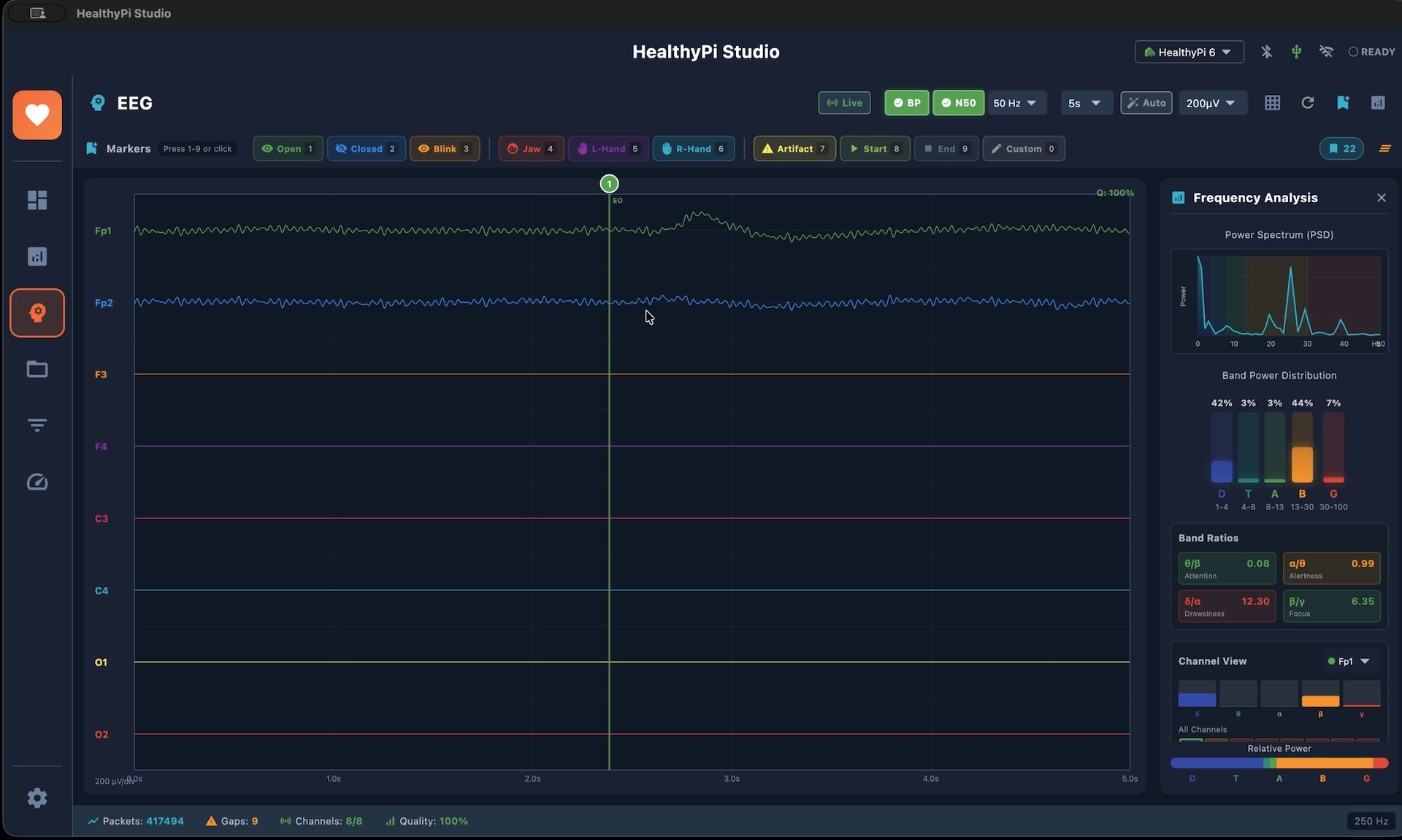
Eight-Channel Waveform Display
The EEG screen displays all eight channels simultaneously with:
- Five-second scrolling window at 250 Hz
- Adjustable Y-axis scale (±50, ±100, ±200, ±500 µV)
- Standard 10-20 electrode labels (Fp1, Fp2, F3, F4, C3, C4, O1, O2)
- Color-coded channels for easy identification
Real-Time Frequency Analysis
The application computes frequency band powers in real-time using FFT analysis:
| Band | Frequency | Associated State | Display Color |
|---|---|---|---|
| Delta | 0.5 - 4 Hz | Deep sleep | Indigo |
| Theta | 4 - 8 Hz | Drowsiness, meditation | Teal |
| Alpha | 8 - 13 Hz | Relaxed, eyes closed | Green |
| Beta | 13 - 30 Hz | Active thinking | Orange |
| Gamma | 30 - 100 Hz | High cognition | Red |
The band power visualization shows both:
- Bar charts for instantaneous power levels
- Time-series trends for tracking changes over your session
Coming Soon: Signal Quality Indicators
We’re working on additional signal quality features for a future update:
- Per-channel connection status with lead-off detection
- Impedance estimation
- Artifact flagging (muscle, eye blink, power line interference)
EEG Signal Verification Demo
To show the EEG module in action, we performed a simple signal verification test, a quick way to confirm the hardware is working correctly. This demonstration takes just a few minutes, requires minimal setup, and produces unmistakable results.
The Setup
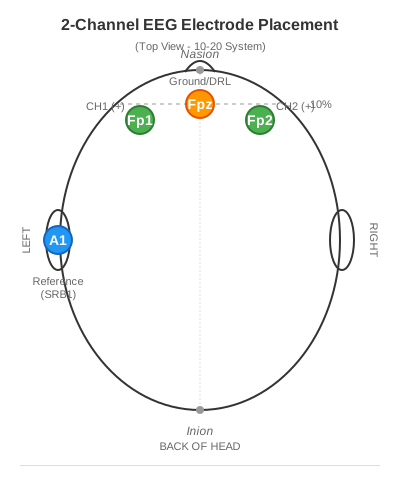
We used a two-channel referential montage with the default firmware configuration:
| Electrode | Position | Purpose |
|---|---|---|
| Channel 1 (+) | Fp1 (forehead, left) | Left frontal signal |
| Channel 2 (+) | Fp2 (forehead, right) | Right frontal signal |
| Reference | A1 (left earlobe) | Shared reference via SRB1 |
| Ground/DRL | Fpz (forehead center) | Driven right leg / bias |
This four-electrode setup captures bilateral frontal activity, perfect for detecting eye blinks, concentration changes, and brain rhythms. For this demo, we simply used standard, small-sized ECG electrodes; all four positions (forehead and earlobe) are in generally hairless areas, so no special EEG caps or conductive gel-in-hair hassles are required.
Test One: Beta Activity During Concentration
With the subject alert and focused, we captured clear beta rhythm (13-30 Hz) activity, the signature of an engaged, active mind.
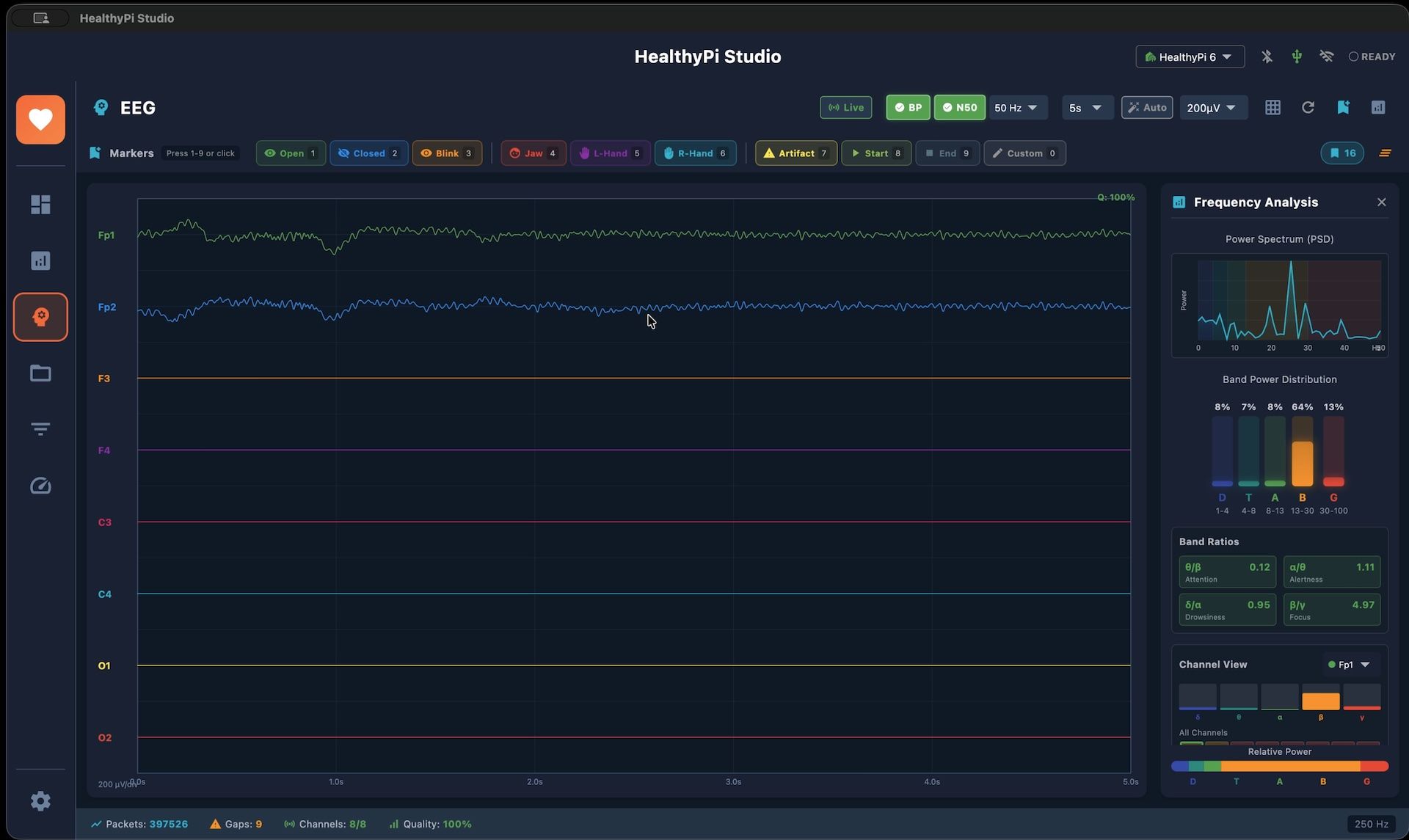
The Frequency Analysis panel shows dominant beta activity at 64% of total band power, with the Power Spectrum (PSD) showing peaks in the 13-30 Hz range. This confirms the system is acquiring real brain signals, not just noise.
(We also attempted the classic alpha blocking test: eyes closed to elicit alpha waves, then eyes open to suppress them. Turns out, relaxing on command while staring at a computer screen is harder than it sounds! The beta activity stayed dominant throughout. Alpha blocking works best in a quieter environment. It’s something to try when you get your own unit.)
Test Two: Eye Blink Detection with Markers
Eye blinks produce large, unmistakable artifacts that are perfect for verifying EEG equipment. We asked the subject to blink several times while we used HealthyPi Studio’s new Markers feature to annotate each event.
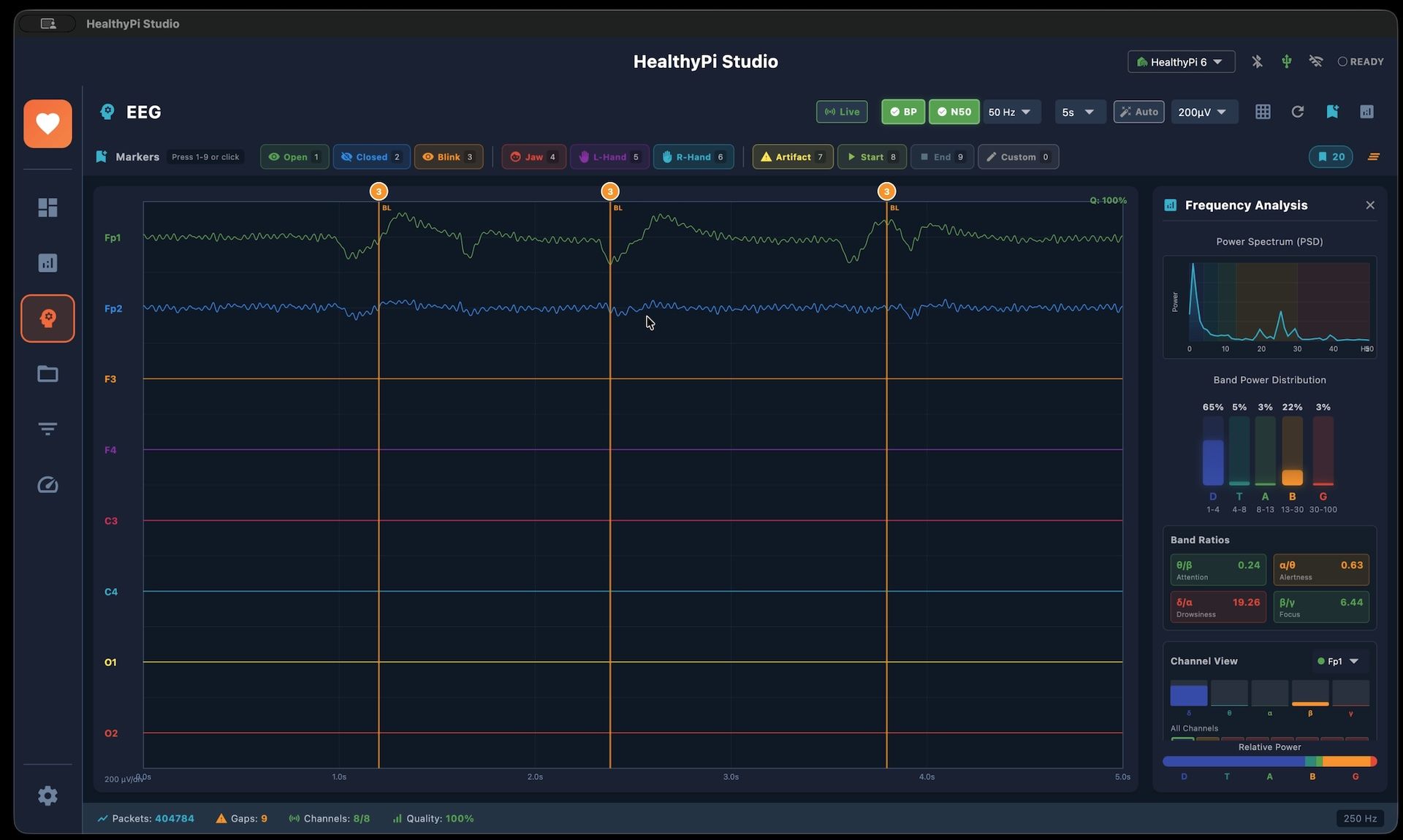
The blink artifacts appear as large deflections on both Fp1 and Fp2 channels simultaneously, exactly what we’d expect from frontal electrodes. Each blink has been marked using the Blink marker (yellow), demonstrating the annotation workflow.
New Feature: Event Markers
Notice the Markers toolbar at the top of the screen. HealthyPi Studio now supports real-time event annotation with customizable markers:
- Open / Closed Mark eyes open/closed periods
- Blink Tag eye blink artifacts
- Jaw Mark jaw clenching (muscle artifact)
- L-Hand / R-Hand Motor imagery markers for BCI experiments
- Artifact Flag noise or interference
- Start / End Session boundaries
- Custom User-defined events
Markers are essential for research workflows, they let you synchronize EEG data with experimental events, making analysis much easier.
What These Results Show
| Observation | What It Confirms |
|---|---|
| Beta activity during focus | System acquires real brain signals |
| Symmetric blink artifacts | Both channels working, good electrode contact |
| Clean baseline between blinks | Low noise floor, isolated USB approach working |
| Real-time band power display | Signal processing pipeline operational |
This simple verification takes under five minutes and confirms your HealthyLink EEG Module is ready for more advanced experiments, from alpha blocking tests to sleep studies to BCI research.
Why This Matters for Your Research
Once you’ve verified your setup is working, the real experiments can begin. With research-grade eight-channel EEG, you can explore:
Sleep Studies: Combine EEG with HealthyPi 6’s built-in ECG and SpO2 for comprehensive polysomnography. Track sleep stages, detect apnea events, and correlate cardiac activity with brain states.
BCI Research: The ADS1299’s low noise floor (<1 µVpp) captures the subtle signals needed for brain-computer interface development. Motor imagery, P300 spellers, SSVEP—all within reach.
Neurofeedback: Real-time band power display enables meditation training, attention enhancement, and relaxation protocols. Watch your alpha waves grow as you relax.
Event-Related Potentials (ERP): With sub-millisecond timing precision and 24-bit resolution, capture P300, N400, and other cognitive markers.
Educational: This verification demo takes five minutes and requires minimal setup. Perfect for neuroscience courses, science fairs, or just exploring your own brain activity.
Open Source, As Always
The EEG firmware, HealthyPi Studio source code, and signal processing algorithms will all be open source. The repositories are currently being prepared and will be made publicly available soon, we’re cleaning up documentation and ensuring everything is well-organized for the community.
Once released, you’ll have access to:
- Firmware: ADS1299 driver and EEG signal processing code
- OpenView Protocol: EEG packet specification for eight-channel streaming
- HealthyPi Studio: Flutter-based desktop app (Windows, macOS, Linux)
- Documentation: Implementation guides for customizing the EEG module
Production Update
We’re excited to share that final design work is nearing completion. The hardware has been thoroughly validated through months of testing and the firmware is stable and feature-complete for the initial release.
What’s happening now:
- Final PCB layout optimizations are being completed
- Component sourcing is finalized
- Manufacturing setup is prepared
- EMI/EMC certification testing is being prepared
- Production is scheduled to begin very soon
We’ll share detailed production updates and shipping timelines once manufacturing is underway. Thank you for your patience as we ensure HealthyPi 6 meets the quality standards you deserve.
Thank You
Building HealthyPi 6 has been an incredible journey. From the tri-core architecture to on-device edge ML to running DOOM (yes, really), we’ve pushed what’s possible with open-source biomedical hardware.
The EEG module represents what we set out to build: research-grade bio-signal acquisition that’s accessible to everyone. Whether you’re a researcher, student, maker, or just curious about the signals your body produces, HealthyPi 6 gives you the tools to explore.
Thank you for your support. We can’t wait to see what you build.
If you haven’t backed us yet, the campaign is closing soon, so be sure to grab campaign pricing before it ends.
Questions about the EEG module or HealthyPi Studio? Drop us a message on Crowd Supply. We’re here to help.