Project update 4 of 10
Introducing HealthyLink: Modular Expansion for Research-Grade Biosignal Systems
by Ashwin WhitchurchHello HealthyPi 6 backers!
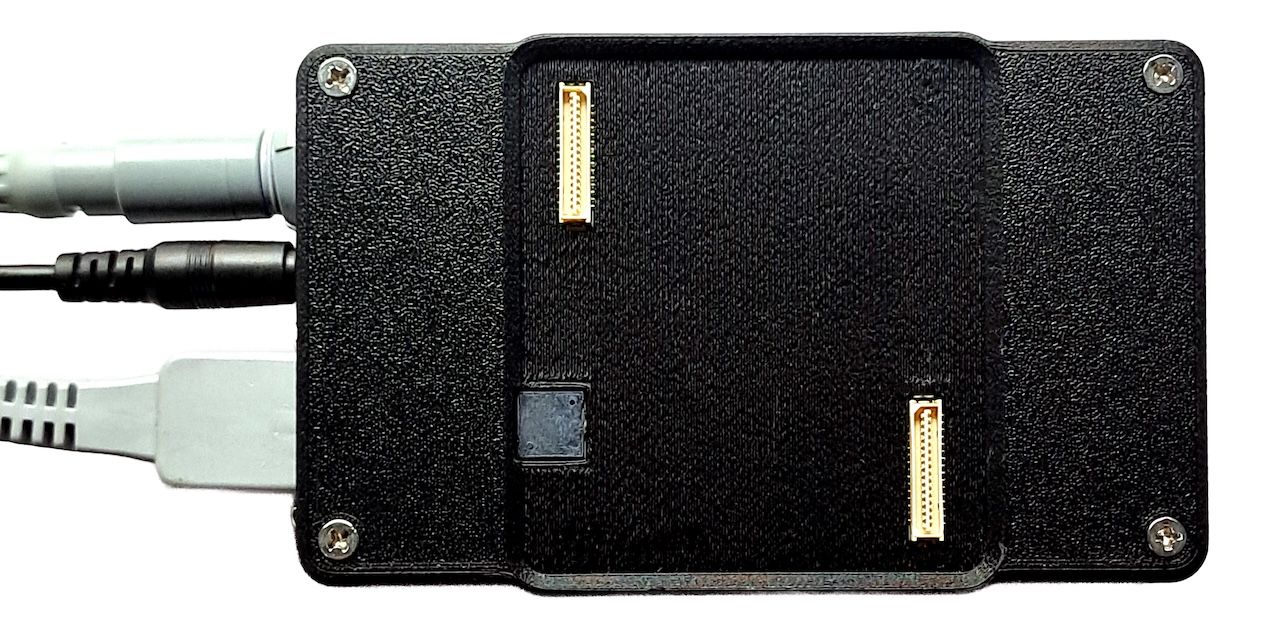
What if your ECG monitor could become an EEG system tomorrow? Or sync with your lab’s stimulus generator next week? Today we’re revealing HealthyLink, a 62-pin modular expansion interface that transforms HealthyPi 6 from a standalone monitor into a configurable research platform.
Why Expansion Matters
Consider a sleep research lab: you need eight-channel EEG for brain activity, GSR for autonomic monitoring, and synchronized triggers for stimulus delivery, all recorded with a common timestamp. With HealthyLink, you stack the modules you need and the system configures itself automatically.
Every research lab has unique requirements. Cardiac researchers need synchronized triggers for stimulus delivery. Neuroscience labs require high-channel-count EEG. Clinical environments may use CAN bus integration with existing equipment.
Rather than building separate devices for each use case, HealthyLink lets you add capabilities through stackable modules, without modifying the core hardware.

What This Means for Researchers
HealthyLink transforms HealthyPi 6 from a fixed-function device into a modular research instrument. Here are just a few examples of what becomes possible:
| Standard HealthyPi 6 | With HealthyLink Modules |
|---|---|
| 3-lead ECG + PPG | + 8-channel research EEG |
| Single-device recording | + Hardware-synchronized multi-modal acquisition |
| Software event markers | + Sub-microsecond trigger I/O for ERP studies |
| WiFi streaming | + CAN bus integration with lab equipment |
| On-device ML inference | + External NPU for complex real-time models |
The expansion possibilities extend well beyond this list; HealthyLink exposes enough interfaces for EMG, GSR, bioimpedance, custom ADCs, and applications we haven’t imagined yet. For labs with evolving requirements, you can start with ECG/PPG and add capabilities as your research demands, without replacing the entire system.
Plug-and-Play Detection
No configuration is required. Plug in a module and HealthyPi 6 automatically detects it via I2C EEPROM, loads the appropriate driver, and starts acquiring data. The same firmware binary supports all module types, no recompilation needed.
Each module contains a small EEPROM that stores its identity, capabilities, and calibration data. When detected, HealthyPi 6’s runtime pin multiplexer reconfigures the STM32’s GPIO registers to match the module type, whether that’s SPI for an EEG AFE, CAN for lab equipment, or GPIO for trigger outputs.
We’re also implementing support for Zephyr’s LLEXT (Linkable Loadable Extensions) subsystem. This allows module drivers—both official and community-developed—to be loaded dynamically from SD card at runtime. New modules can be supported without reflashing the main firmware and driver updates can be distributed independently.
Available Interfaces
| Interface | Purpose |
|---|---|
| SPI4 / SPI6 | External ADC, DAC, AI accelerator |
| USART2 | External MCU, GPS, modems |
| FDCAN | Lab equipment, automotive |
| I2C3 | Module detection + sensors |
| ADC | 11 analog inputs for biosignal expansion |
| GPIO | five digital I/O for triggers and interrupts |
Power Budget
| Rail | Capacity |
|---|---|
| 3.3 V | 500 mA (LDO regulated) |
| 5 V | 1 A (direct from USB/battery) |
Expansion Modules
We’ve designed HealthyLink with several research applications in mind:
GPIO Breakout Module (Included)
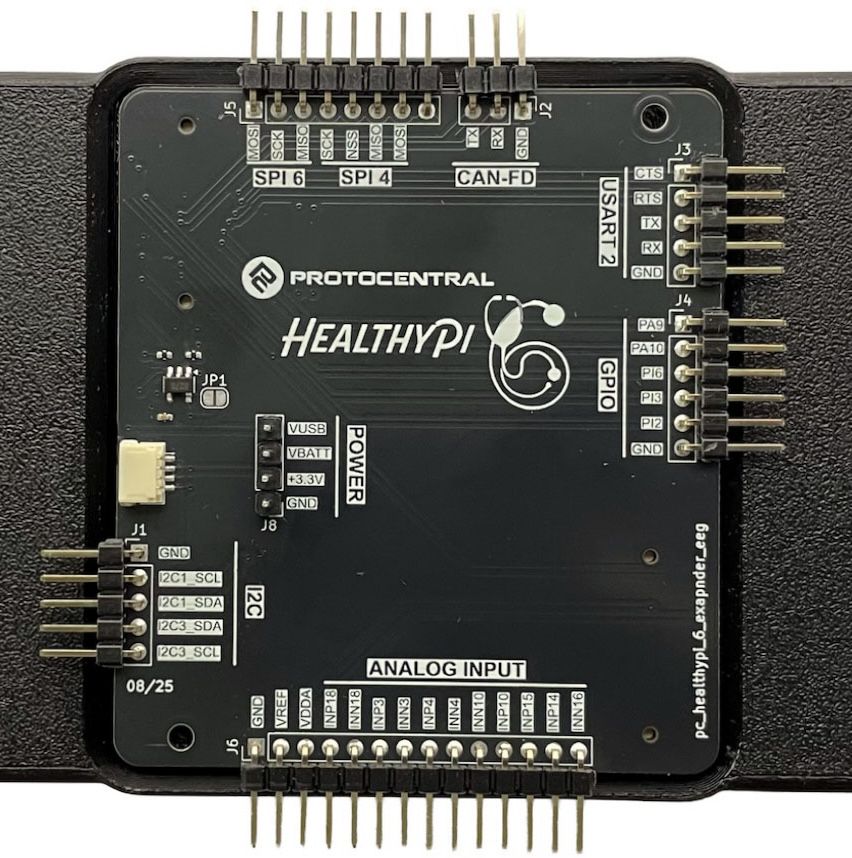
The GPIO Breakout module ships with every HealthyPi 6 unit. It connects to the two 31-pin HealthyLink connectors and breaks out all signals to standard 0.1" headers for prototyping. You can use this module to experiment with the expansion interface, develop custom circuits, or connect logic analyzers for debugging.
AI Accelerator: STM32N6 NPU Module
| Specification | Value |
|---|---|
| Processor | STMicroelectronics STM32N6 |
| NPU Performance | 600 GOPS INT8/FLOAT32 |
| Interface | SPI4 |
| Status | In Development |
While HealthyPi 6’s M4 core handles beat classification, some applications need more computing power. The AI Accelerator module offloads inference to the STM32N6’s dedicated Neural Processing Unit, enabling real-time analysis with larger and more complex models: sleep staging from EEG, continuous arrhythmia detection, stress classification from HRV, or running multiple specialized models simultaneously for multi-modal sensor fusion.
EEG-8CH: 8-Channel EEG/EMG/EOG Module
| Specification | Value |
|---|---|
| AFE | Texas Instruments ADS1299 |
| Channels | eight differential |
| Resolution | 24-bit |
| Sample Rate | 250/500/1000/2000 SPS |
| Status | In Development |
| Interface | SPI4 |
Eight channels of 24-bit acquisition for EEG, EMG, and EOG—ideal for sleep studies, BCI research, and neurofeedback. Supports standard research montages (average reference, linked-ear) without hardware modifications.
Trigger I/O: Lab Synchronization
| Specification | Value |
|---|---|
| Outputs | 4x push-pull, 5 V tolerant |
| Inputs | 4x with Schmitt trigger |
| Timing | <1µs latency (sufficient for single-trial ERP analysis) |
| Connector | BNC or DB-9 |
| Status | Planned |
Critical for event-related potential (ERP) studies, stimulus delivery synchronization, and multi-device setups. Hardware timestamping ensures sub-microsecond precision.
CAN Interface: Lab Equipment Integration
| Specification | Value |
|---|---|
| Protocol | CAN-FD |
| Bus Speed | 125k–1M (CAN), 1–5M (CAN-FD) |
| Transceiver | TJA1042 (isolated) |
| Termination | Switchable 120 Ω |
| Status | Planned |
Connect HealthyPi 6 to existing lab infrastructure—stimulus generators, motor controllers, or custom equipment. CAN-FD’s deterministic timing makes it ideal for closed-loop experiments.
Additional Modules (Future)
We’re exploring additional signal acquisition modules based on researcher feedback:
- GSR: Galvanic skin response for stress and autonomic studies
- Bioimpedance: Body composition and fluid monitoring via tetrapolar impedance measurement
- Blood Pressure: Continuous non-invasive blood pressure via pulse transit time or oscillometric cuff interface
- High-Resolution ADC: 24-bit precision ADC for custom transducers and research sensors
Stackable Architecture
HealthyLink supports up to four stacked modules (limited by I2C address space). Each module uses a different address and interfaces are automatically partitioned to avoid conflicts. For example, you could stack the EEG-8CH module with the AI Accelerator and Trigger I/O modules for a complete neurophysiology setup.
Community Modules: Build Your Own
HealthyLink isn’t just for official ProtoCentral modules. We’re publishing complete design guidelines, reference schematics, and EEPROM programming tools so you can build your own module. Whether it’s a custom sensor interface, a specialized amplifier, or an entirely new modality, HealthyLink provides the foundation for community-driven innovation.
Module Availability
Every HealthyPi 6 ships with the HealthyLink connector and GPIO Breakout module, so you can start experimenting with the expansion interface immediately.
Additional modules will be released as add-ons:
- EEG-8CH: In development, timeline to be announced
- AI Accelerator (STM32N6): In development, timeline to be announced
- Trigger I/O: Planned
- CAN Interface: Planned
HealthyLink extends the life of your HealthyPi 6. As your research needs change, you add modules rather than replace the device.
We’d love to hear from you: Which modules matter most to your research? Let us know and stay tuned for future updates!
N.B.: This update describes the HealthyLink expansion architecture as of January 2026. Module availability and specifications may evolve during development.