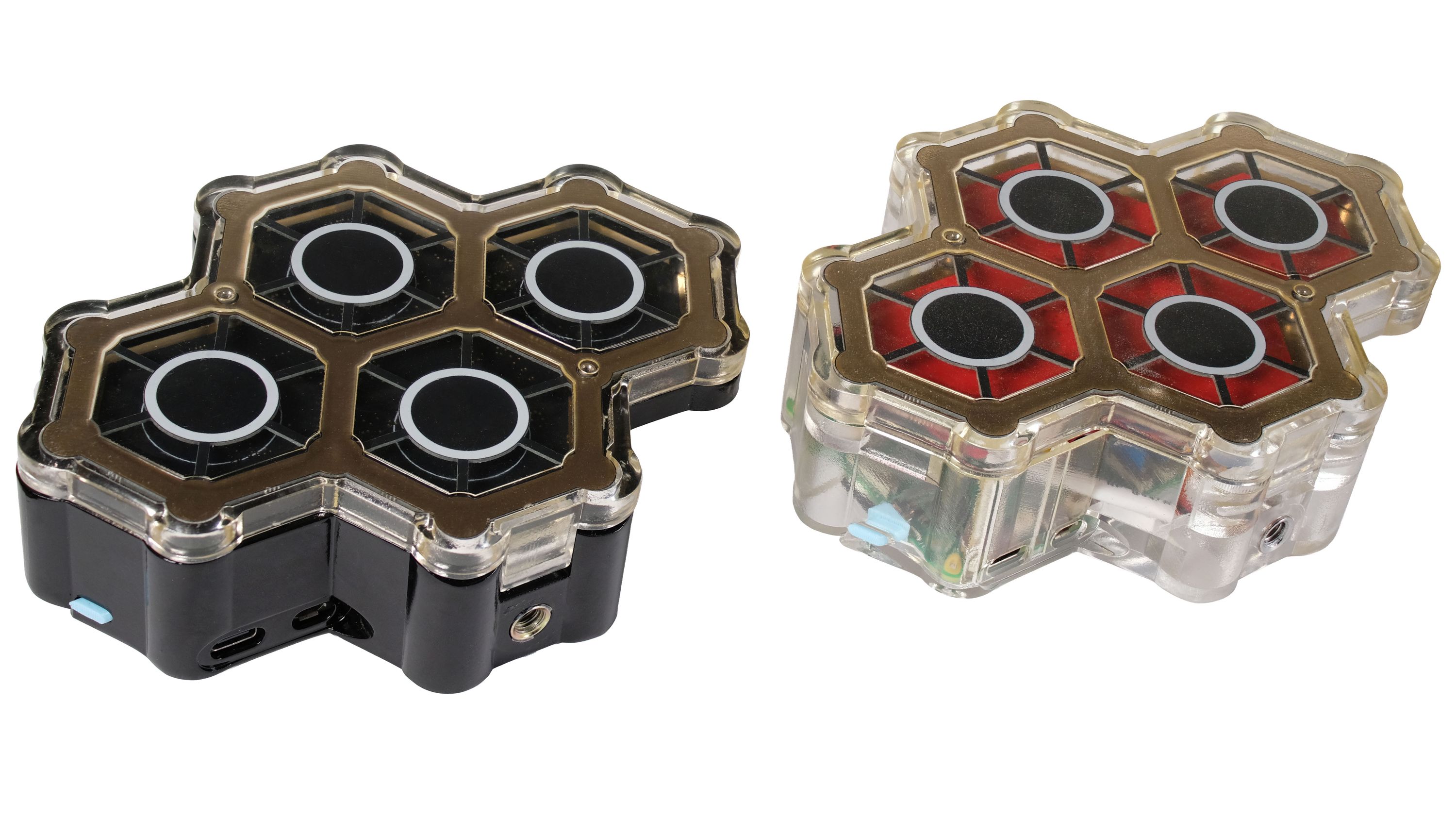
We have liftoff! QuadRF exceeded its funding goal in just 22 hours, making it one of the fastest campaigns at this level in Crowd Supply history. Thank you all for the incredible support (and a special shoutout to @EuphCat on our Discord for pushing us across the line with his Mobile Expansion Pack order!).
We’re still going! For those who make it into the first 1,000 backers, we are pushing hard for early deliveries. We already have, or are currently ordering, the part inventory for a full 1,000 QuadRF Kits so they are well into assembly before the campaign ends on August 6th, allowing us to ship Batch 1 quickly. We can’t wait to get this hardware into your hands and see how you use spatial RF out in the wild. If you haven’t backed yet, don’t forget to hit that yellow button soon!
This milestone has me reminiscing about the early days of the project. The first prototypes were pretty wild: inflatable array structures, 3-phase AC power… After a few too many explosions and a fire from the distributed power-balancing networks going into oscillation, it was clear we needed to keep it simple, rigid, and scale down the power before scaling up. A main goal of Earth-Moon-Earth communication needed only a 240-antenna array, and that could be powered by a low-cost LiFePO4 battery. Fast forward through a few dozen RF tile PCB design iterations, the first MoonRF was born in October 2025. It wasn’t actually all that expensive to produce (well, if you ignore the hundreds of earlier revision PCBs littered around my desk at that point!).
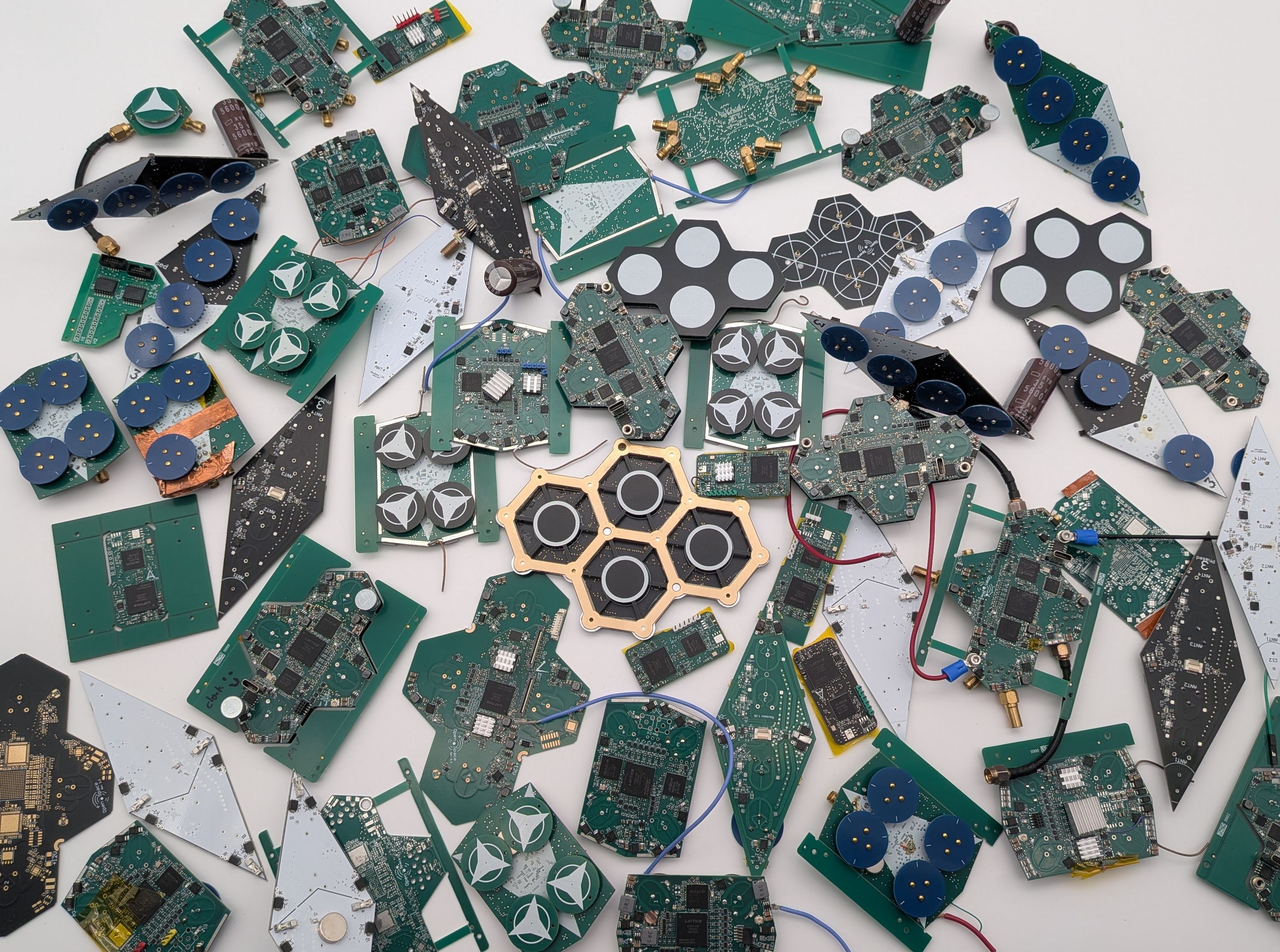
Looking at some of those early prototypes reminded me how much the design evolved over time. The tile took on all different shapes and sizes, the interconnects came and went through their USB-C phase, dozens of ADC designs were built, and RF layout, front-end, and antenna iterrated many times between sim and actual boards with VNA measurment. On the inside, the calibrations got better, the DSP implementations more streamlined, and the synchronization error was driven down to the single picosecond level.
But as a first product, the MoonRF was still limited to those with an amateur radio license, and it involved high power that required care and training. It also required producing many of these 4-antenna RF tile boards (later dubbed "Quads") with high yield. All-in, it just wasn’t affordable enough for most hobbyists who wanted to experiment with phased arrays for the first time.
That’s when we realized a single 4-antenna tile was a perfect entry-level platform all by itself. Andy and Roy joined in and leaned hard into that vision for a first released product. In the end we produced something far more exciting than initially anticipated.
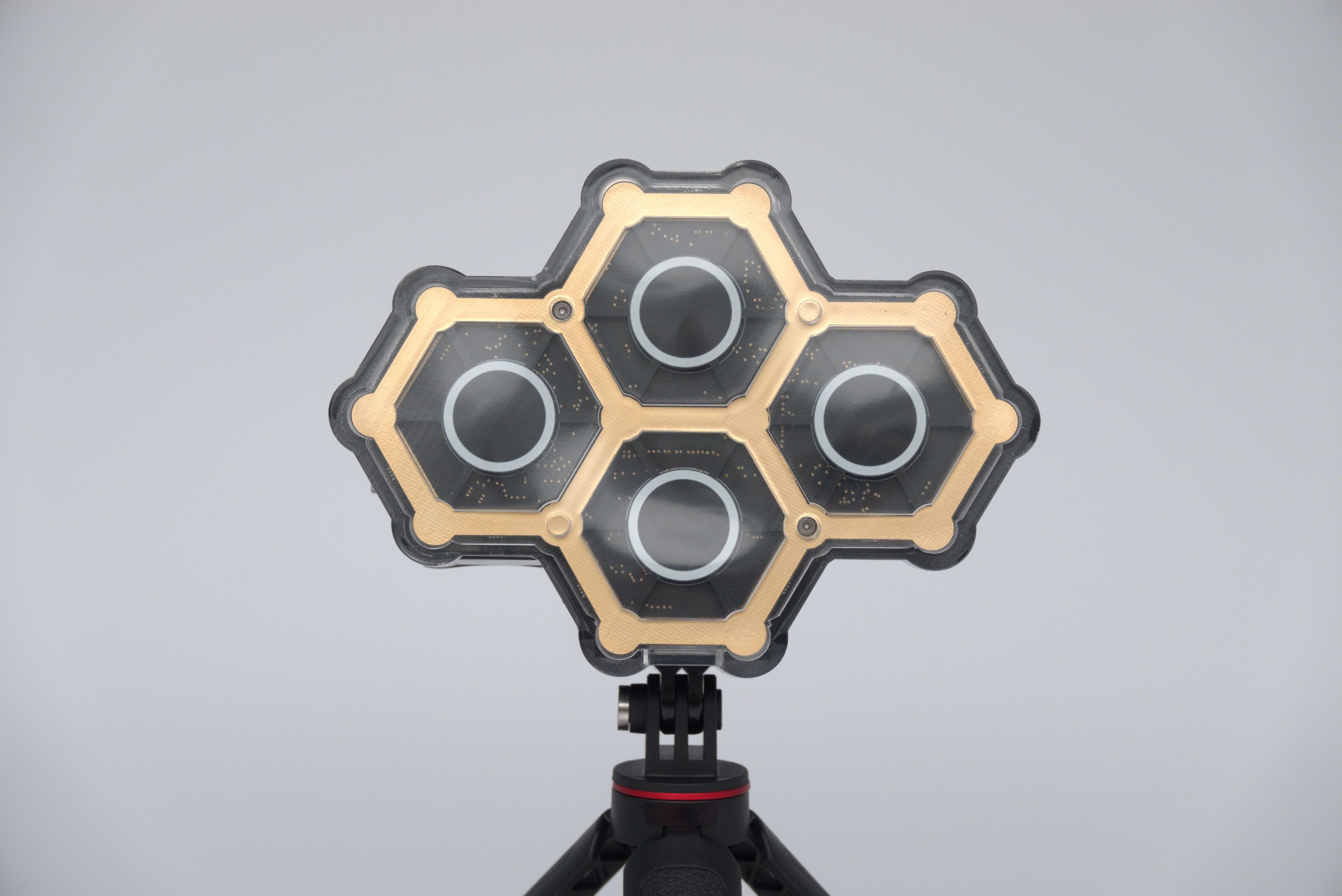
First, the QuadRF is incredibly accessible. We call it a kit, but it’s fully assembled, tested, and works instantly out of the box. Through the Web GUI, you have direct desktop access to a full suite of SDR tools to get started immediately. It’s also a complete 4x4 MIMO transceiver, meaning it can handle mesh networking and automatic beamforming. But the arguably coolest application, the augmented reality RF, started out as a quick implementation of something I had actually done for sound waves two decades earlier as a young DSP student. The QuadRF Closer Look video on YouTube was actually our very first try at tracking quadcopters and other objects, and I think the results speak for themselves. The software stack is 100% open-source under GPLv2, so we’re most excited to see how others extend these capabilities to new applications.
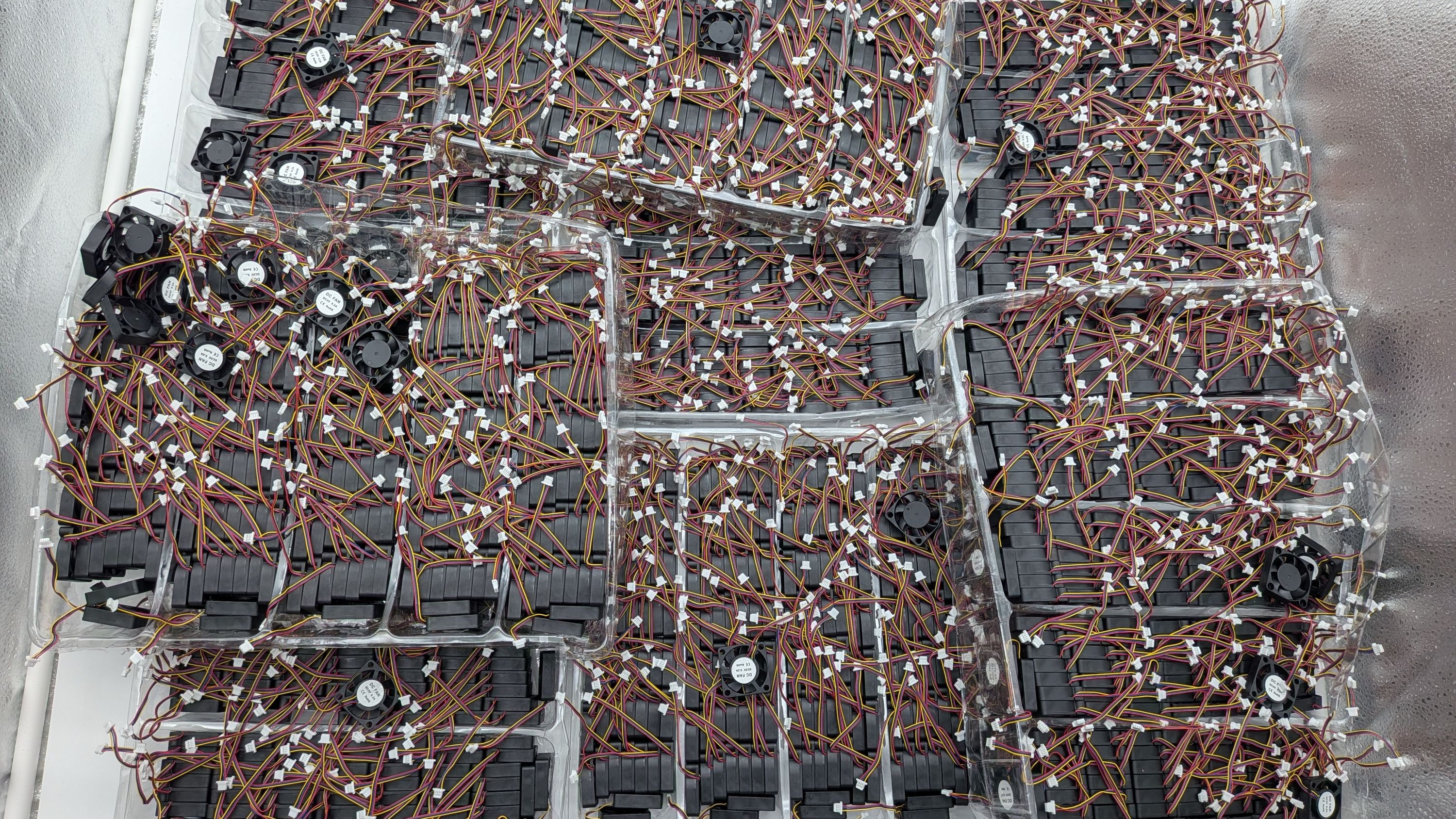
We Have a Lot of Fans!
Literally… we have a couple thousand cooling fans stockpiled right now. It’s a bit daunting to think that we’ll be transforming each of these into a fully assembled QuadRF Kit in just a couple of months! As for the fans themselves, they work great. We had them customized for high airflow, which is critical to ensure the Pi 5 never throttles its CPU—even when all four RF transmitter power amplifiers are blasting away nearby.
The fans are just one box in the garage. As components start arriving, we’re making space for antennas, RF boards, enclosures, and tripods. We’re really looking forward to having everything staged and seeing the assembly line humming along at our larger Studio City, CA location.
On the supply chain front, the only IC component we currently have fewer than 1,000 units of is the Lattice ECP5 FPGA (-45F), but we are actively working to secure the rest of that allocation.
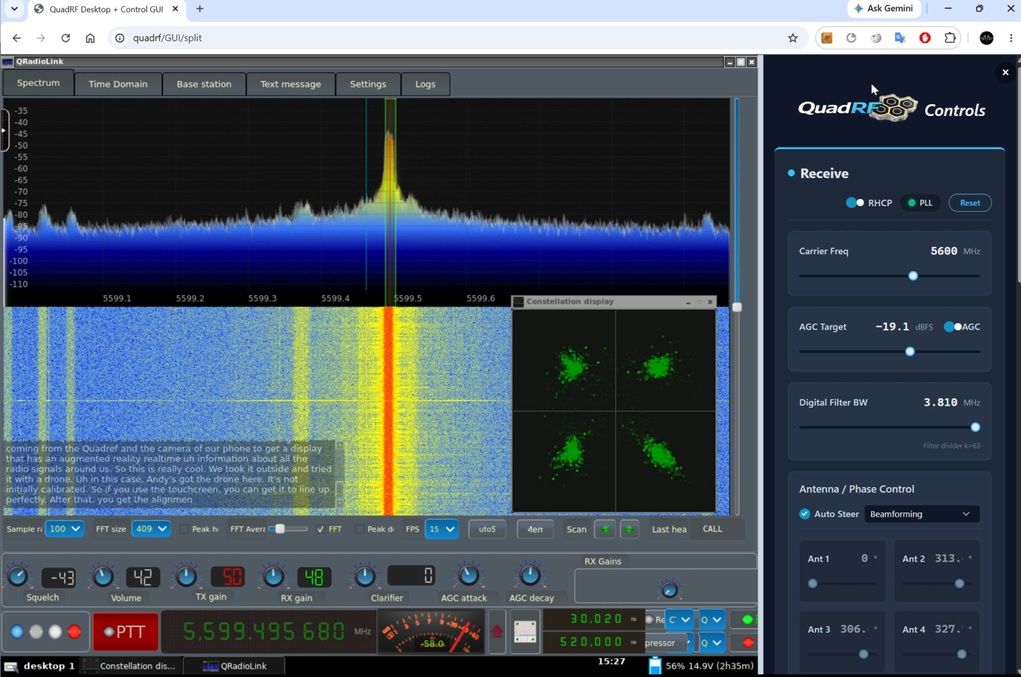
Finally, there has been great progress cleaning up the software so that everything can be installed automatically on a fresh DietPi OS. Thats critical to making it easy for everyone to contribute to the open source software. We’ve also been adding more features, such as a battery life indicator to the desktop, so you know exactly how many hours of juice you have left when running off the Mobile Expansion Pack. (We’re seeing a solid 9 hours in idle, 6.5 hours in Rx, and 5 hours in Tx+Rx). It’s a great little detail, and we’re adding many more software improvements this month!
In the meantime, we’ll keep you posted each week on how everything is progressing! Again, thank you for all the support, and we can’t wait to help low-cost SDR enter its phased-array era!