Project update 3 of 3
Plans for Injection Molding, Wi-Fi Analysis, Teardown 2026 in July, and GRCon in September
by Martin McCormickWeek two of the campaign is here, and QuadRF has 400 backers and counting. Thank you all for the great support getting QuadRF launched!
See QuadRF at Teardown 2026!
For those who want to get hands-on earlier with the QuadRF, Roy will be attending Crowd Supply’s awesome Teardown 2026 event in Portland (July 24-26). You’ll be able to play with the QuadRF augmented reality and try mesh networking demos in person! More information at QuadRF: Real-Time RF Augmented Reality and Open-Source Phased Arrays. Be sure to stop by and check it out!
Production Update
Given the rising demand numbers, we’ve decided to switch to injection molding for the front enclosure. We’re ordering the molds this week and should have the first pieces right as the campaign wraps up in a month. This upgrade will significantly improve front clarity, consistency, strength, and UV resistance for those using QuadRF outdoors. We’re excited to show off how it looks when the first samples arrive!
Otherwise, we are continuing to stock up on Raspberry Pis, microSD cards, and tripods. We’re about to kick off 1000-unit PCBA orders for the RF boards after a final check on the latest batch of 100. We’ve had to adapt to various vendor shortages, but nothing is currently holding up our fast timeline. So far, so good!
From Seeing Signals to Controlling Them
The ability to visually see wireless signals has garnered most of the attention with QuadRF these days, but you can do much more when you click an RF source. After QuadRF automatically locks onto a frequency and tracks it with beamforming, you can pass raw I/Q samples to and/or from just about any software-defined radio application!
One of those programs is gr-ieee802-11, an open-source Wi-Fi stack spanning from raw RF waveforms all the way up to TCP/IP packets. Having access to the full physical and MAC layers lets you bypass the limits of standard Wi-Fi adapters. You can literally "fork Wi-Fi," modifying the core protocol to make your own custom Tx/Rx wireless links. By pushing 802.11 frames into non-standard bands or compressing bandwidths, you can optimize for longer-range point-to-point links that won’t show up on other Wi-Fi network analyzers (unless they have another QuadRF, of course!). In the field, IT professionals can tame IoT hell by using QuadRF’s AR to visually hunt down airwave-hogging devices before pivoting to deep packet inspection to see what those devices are actually doing.
For security and forensics, QuadRF captures what standard hardware ignores. Typical Wi-Fi adapters silently drop malformed, malicious, or corrupted frames before they ever reach Wireshark. With gr-ieee802-11, you can analyze everything—inspecting the lower layers to pinpoint exactly why packets fail, whether from hidden node collisions or targeted jamming. Researchers can push these boundaries further using RF fingerprinting, PHY-layer fuzzing, or by hiding invisible data streams inside OFDM subcarriers that commercial cards just write off as noise. Looking ahead, leveraging QuadRF’s full-duplex MIMO and beamforming could really enhance emergency mesh networks like AREDN through dynamic, simultaneous relaying.
You can run gr-ieee802-11 directly on the QuadRF, but for wider channels (20 MHz+), this is a case where shipping the I/Q samples over Gigabit Ethernet helps offload the heavy compute to a beefier PC. It’s really easy to do, you don’t have to install any new libraries on your PC. Simply connect an Ethernet cable between the QuadRF and your computer, and open the gr-ieee802-11 examples in GNU Radio Companion. Replace "Ettus USRP Source" with a "Soapy Custom Source" block and point it to the QuadRF over the Ethernet by setting: Device arguments: remote=quadrf.local. This will automatically find the QuadRF and pulls Rx I/Q over the network (or sends Tx I/Q if you add a Soapy Sink). Any sample rate you configure will automatically be provided by the QuadRF, which does the resampling internally to minimize Ethernet traffic.
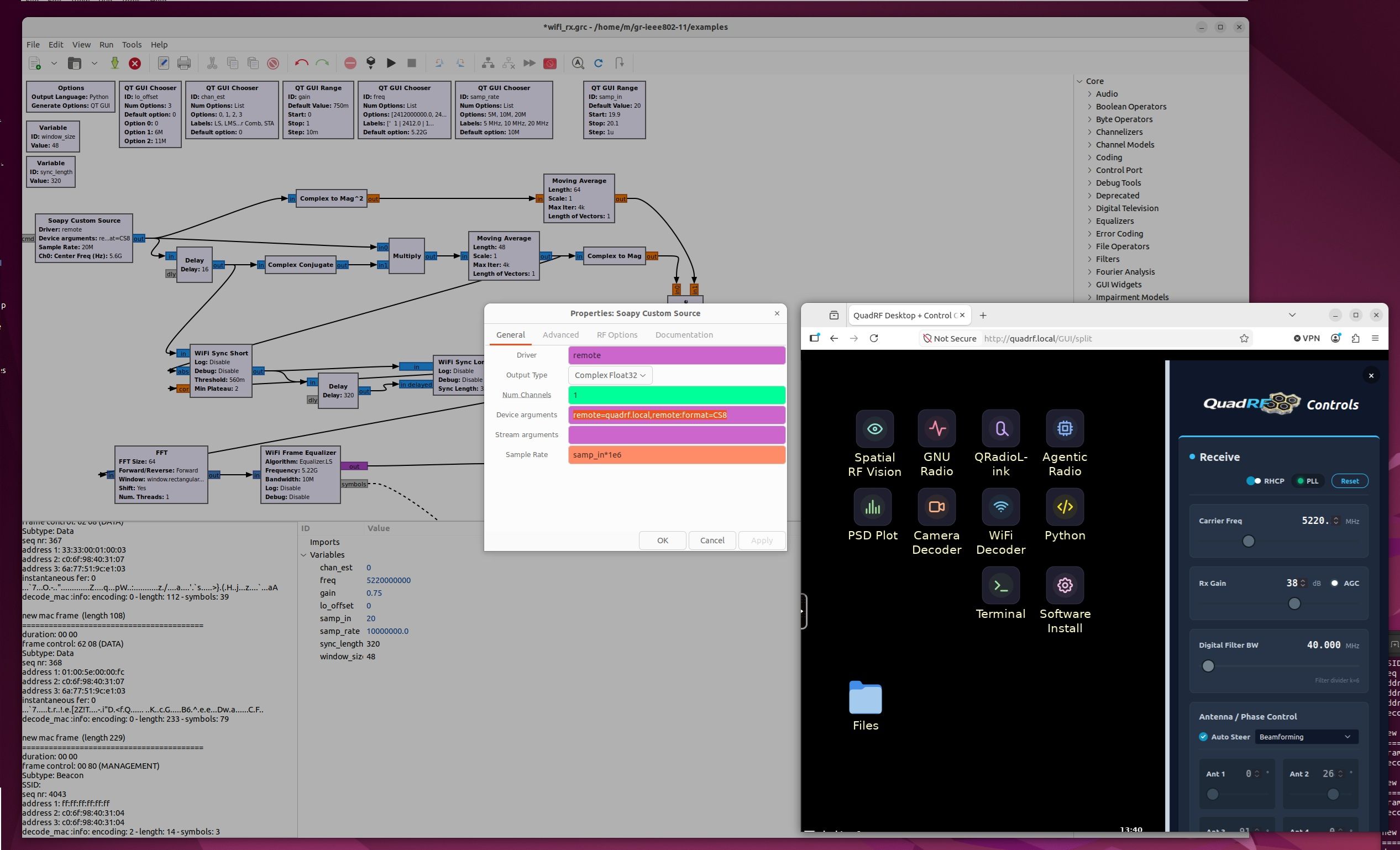
From there you just press play and you’ll start to see the raw OFDM constellation and decoded packets stream in! We see flickers of QAM-16, QPSK, and BPSK from our local Wi-Fi network. This data can be saved to a wifi.pcap file and imported into Wireshark to analyze further, which compared to normal air captures, includes added details like signal-to-noise ratio and channel state information.
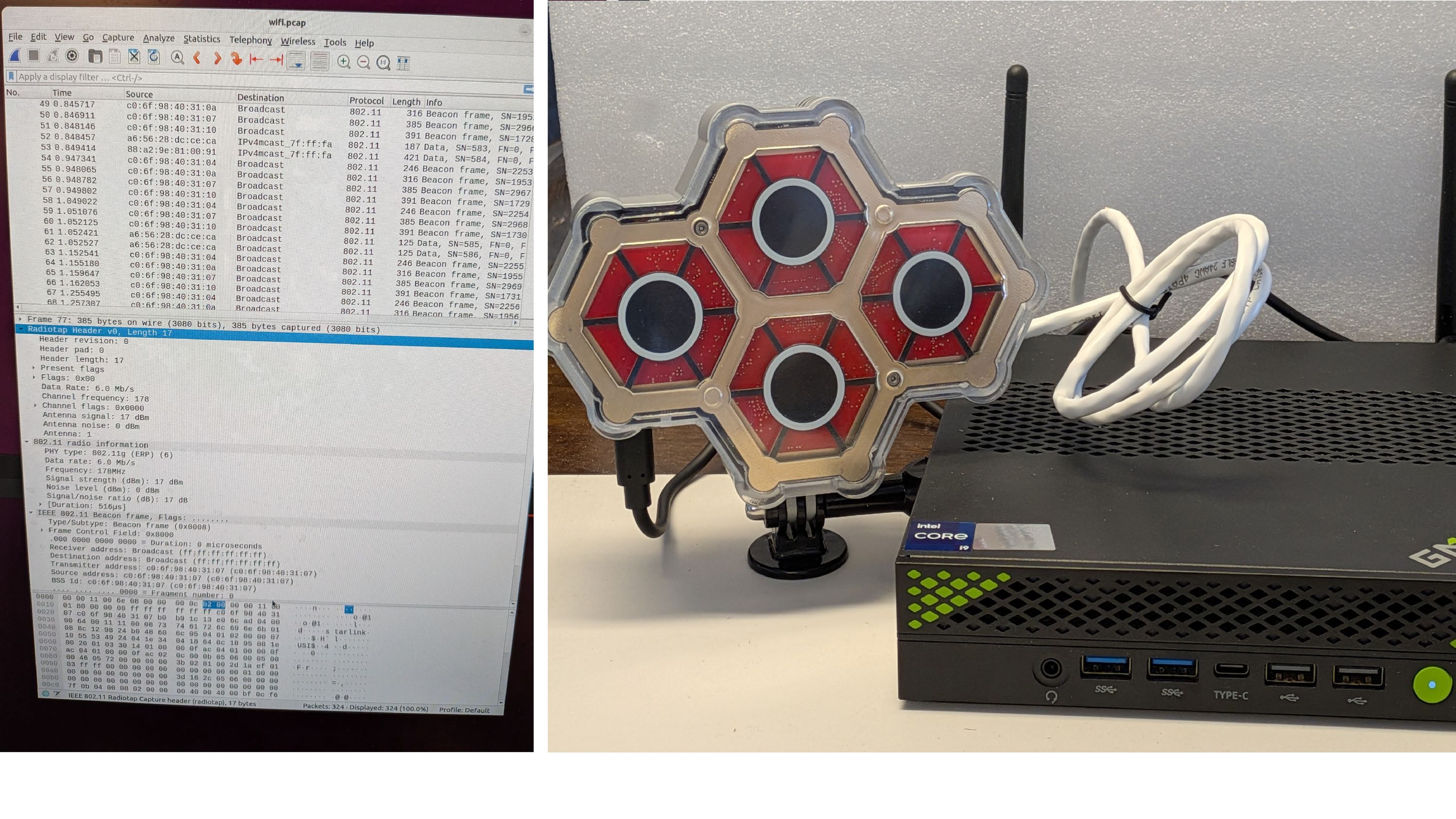
We can’t wait to see what kind of custom protocols and physical-layer research you all build with QuadRF. If you have questions or ideas, drop them in the question form! Also, speaking of GNU Radio, we plan to attend the GNU Radio Conference (Sep 21-25), so be sure to see our talk if you make it to Raleigh, NC!
Until next week,
— The QuadRF Team