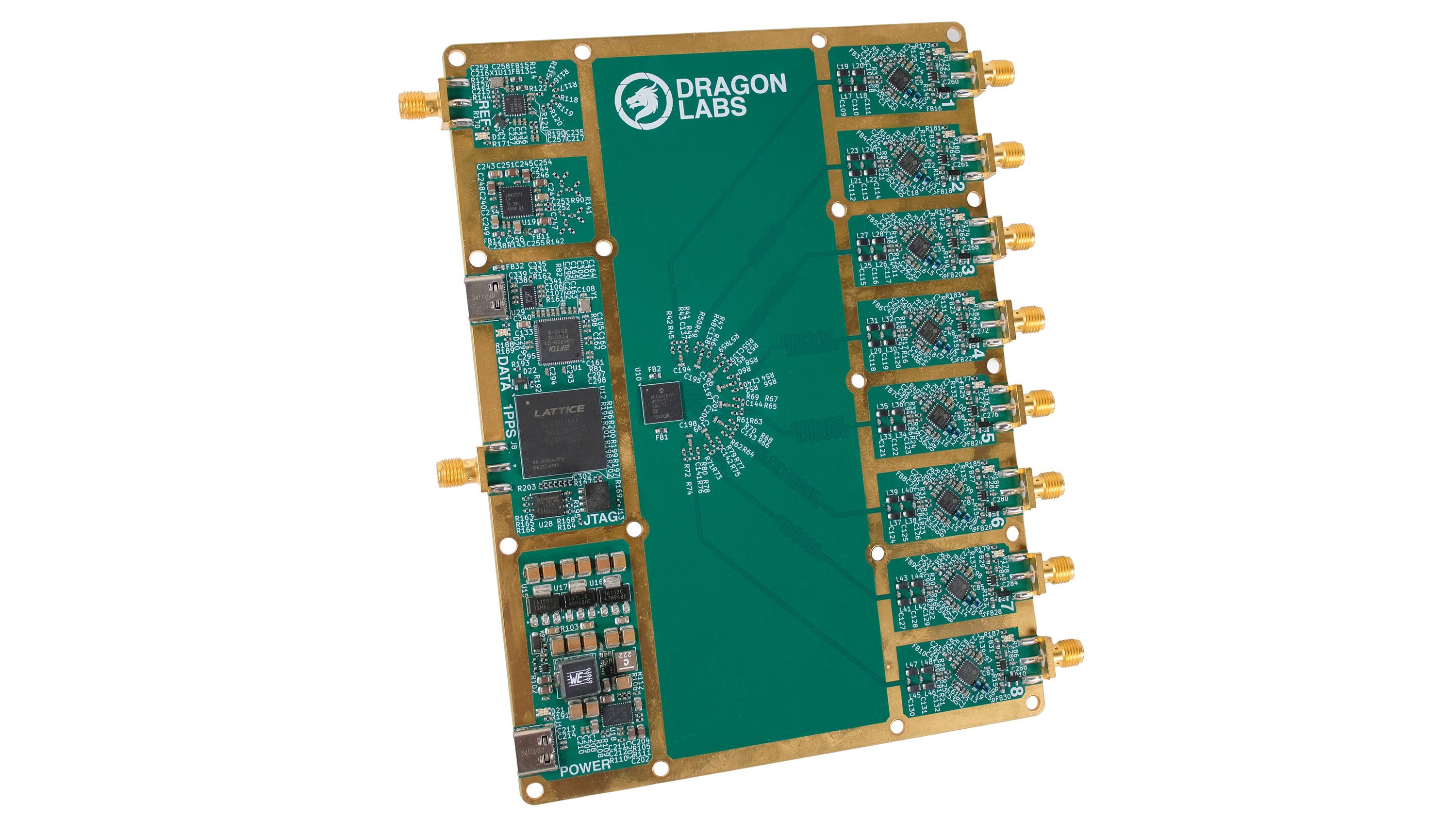
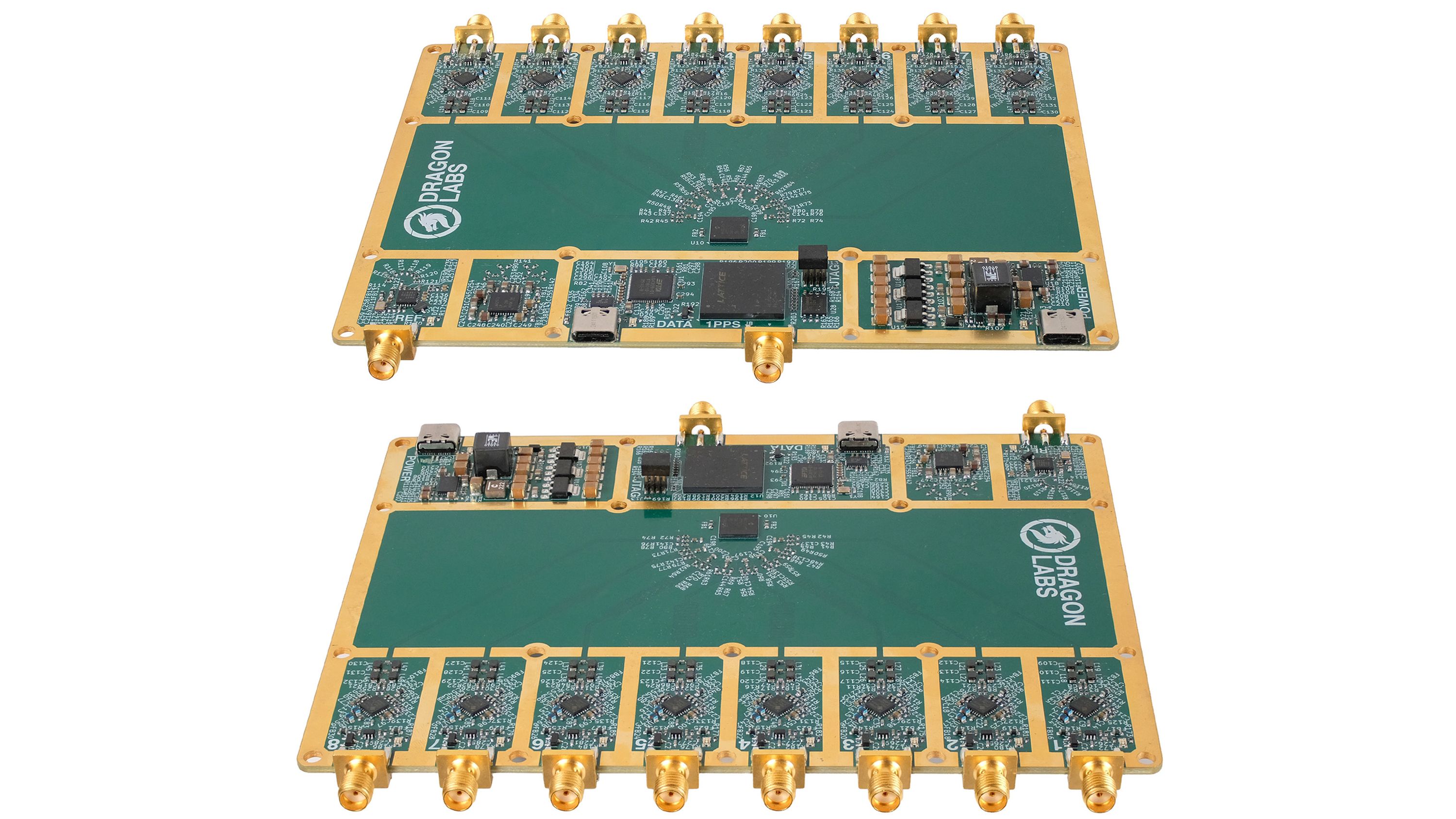
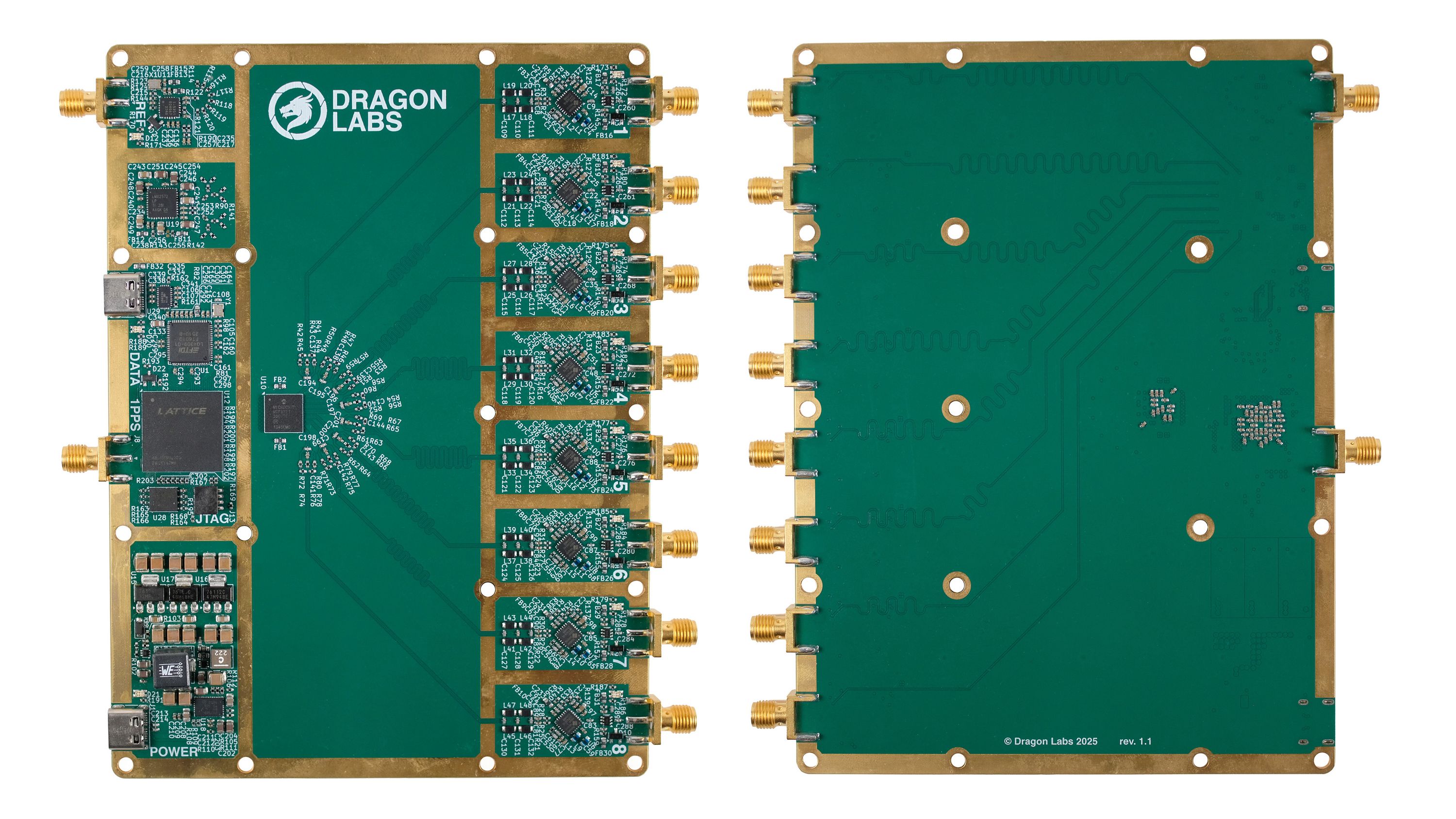
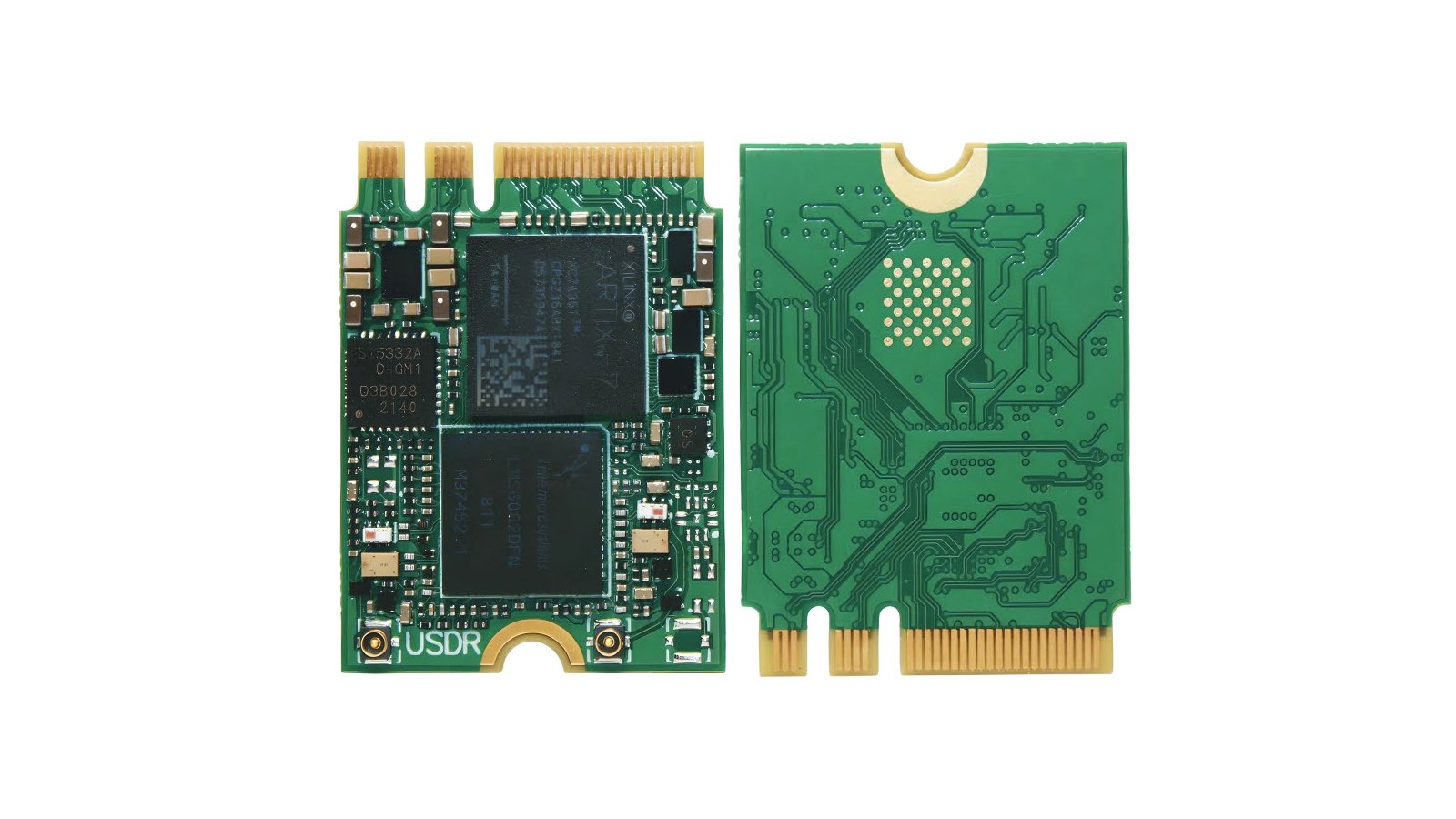
Dragon Labs CR-8 is a high-performance, yet affordable, 8 channel coherent SDR receiver. It is capable of 8MHz per channel with 12 bits of dynamic range and can tune anywhere from 25MHz to 1750MHz. That’s more channels, more bandwidth and more dynamic range than the KrakenSDR, giving you more capability.
It can operate with all 8 channels coherently, or with an arbitrary set of coherent and noncoherent groups. This can be used for example to be coherent on two frequency bands at once by having one set of channels tuned to one frequency, and the others to another frequency. If desired, all channels can even operate completely independently while remaining perfectly synchronized in time.
CR-8 was designed by Alexandre Rouma, known for creating the SDR++ software, as his masters thesis. You can read more about how the CR-8 was designed, prototyped and tested in his thesis paper. Alexandre then went on to found Dragon Labs, which is now run by close friends while he works on his PhD.
Advanced RF Abilities in an Accessible Package
Coherent receivers have many fascinating uses that amateur radio operators and hobbyists have not been able to experiment with much due to the high cost of the hardware and steep learning curve. Thanks to its high channel count, coherence and phase precision, the CR-8 is very well suited to many array processing algorithms:
- Direction Finding: Find the direction of arrival of radio signals around you using an array of identical antennas. You can even move around to triangulate the exact geographic locations of transmitters!
- Beam Forming: Point your antenna array virtually to focus on the signals you want to receive. The antennas don't move, math does all the work!
- Antenna Diversity: Combine the signals received from a set of arbitrary antennas to get rid of noise. Two antennas can increase the signal to noise ratio by up to 3 dB, 4 antennas by 6 dB and 8 antennas by 9 dB.
Features and Specifications
Hardware
- Channels: 8
- Bandwidth: 8 MHz per channel
- Sample Depth: 12 bits
- Tuning Range: 25 MHz to 1750 MHz
- Coherence: Any combination of channels, up to all 8.
- Phase Error: Less than 1° at 1750 MHz (More measurements necessary)
- Timing Error: Less than 100 ps
- Coherent tuning time: 25 to 50 ms Expected to be reduced to under 10 ms
- Onboard Oscillator: TCXO, 2.5 ppm over -20°C to +85°C (-4°F to 185°F)
Electrical Specifications
- Data Interface: USB 3.0 Type-C
- Power Input: USB Power Delivery, 9 to 15 V, 15 W
- Clock Input: SMA, Industry Standard 10 MHz 3.3v CMOS, compatible with most GPSDOs
- 1PPS Input: SMA, Industry Standard 3.3 V CMOS, compatible with most GPSDOs\
- RF Inputs: 50O hm SMA. Max 10 dBm
Physical Specifications
- Size: 15.8 x 11.7 x 1.6 cm (6.22 x 4.6 x 0.63 in)
- Weight: 105g (0.231 lbs) (without case)
- Operating Temperature: -20°C to +85°C (-4°F to 185°F).
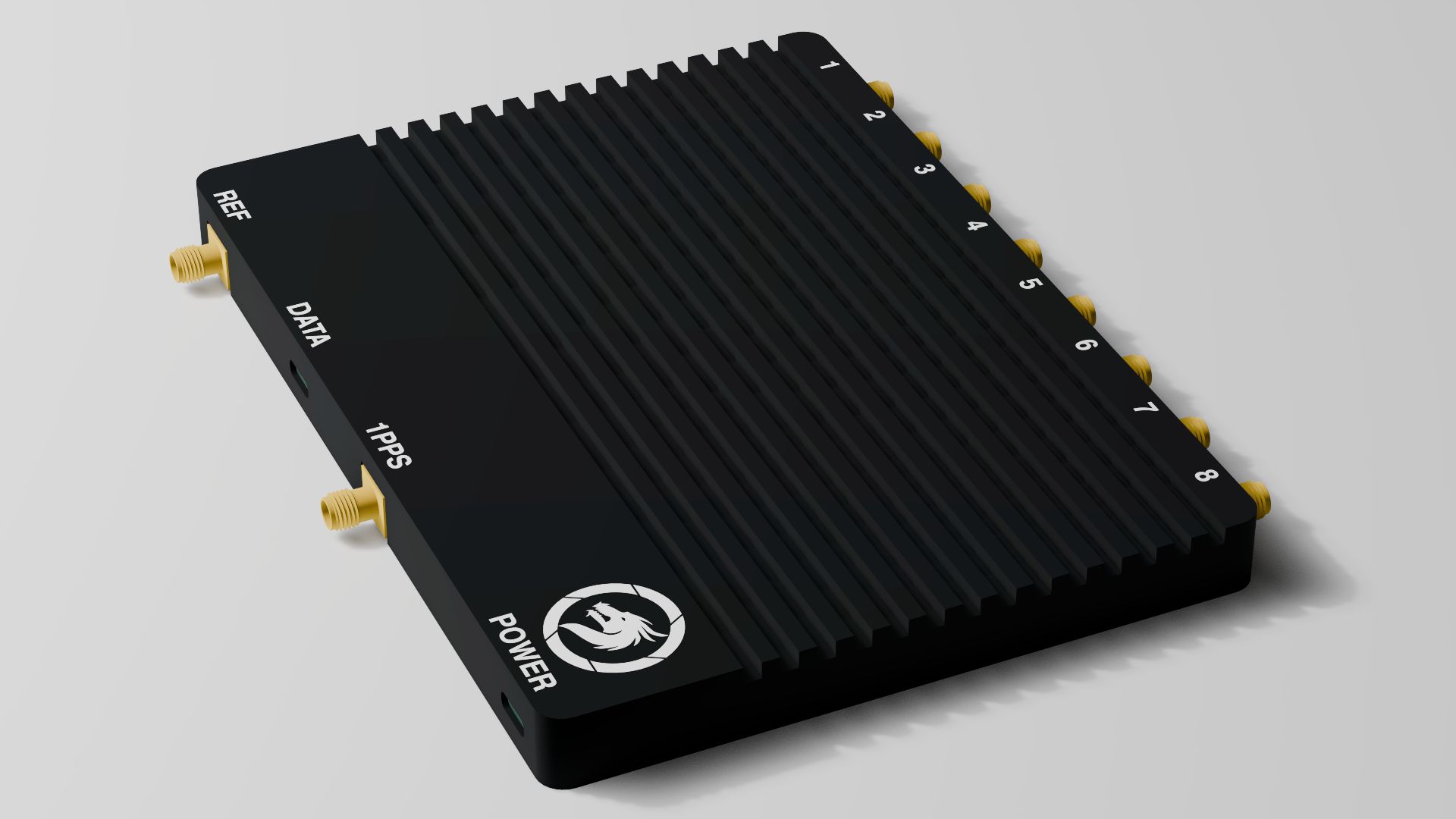
- Optional CNC aluminum case: Improves cooling, increases channel isolation, and protects the PCB
Software Integration
SDR++
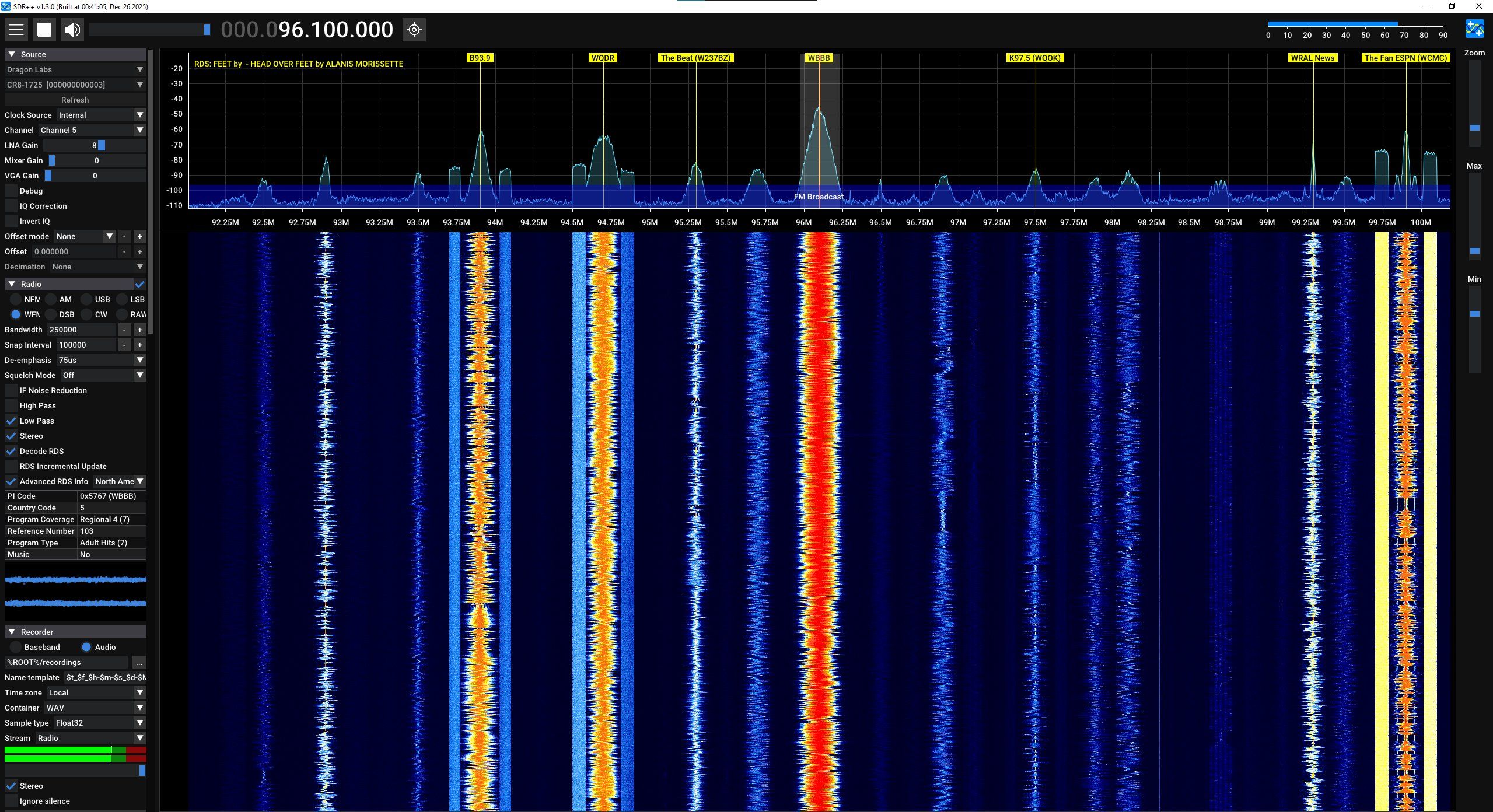
The CR-8 already has native support within SDR++, making it the ideal software to experience its RF performance. The CR-8 can therefore already be used for all your spectrum browsing, SIGINT and general receiving tasks.
SatDump
The CR-8 will also be natively supported in SatDump, a popular satellite data processing software. Due to the CR-8’s high bandwidth, dynamic range, sensitivity and selectivity, it is a perfect candidate for VHF to L-band SATCOM. In the longer term, the multichannel and coherence capabilities of the CR-8 may also be taken advantage of for simultaneous multi-band reception, beamforming and diversity reception, allowing for even higher receive performance.
GNUradio
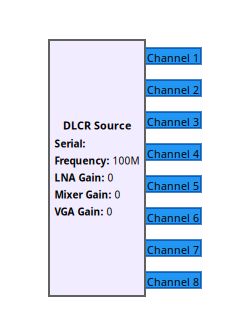
The CR-8 comes with a native GNUradio source block letting you use it directly within your flowgraphs and avoiding the need for performance limiting abstraction layers.
C API and Documentation
The CR-8 comes with a simple but powerful C API that gives you full control over the device and provides the received samples as synchronized buffers of industry standard 32bit floating point complex values. You can check out a pre-release version of this API and it’s documentation on our github page.
SoapySDR and Other Software
For other software, you can always use the CR-8 through the SoapySDR driver. Do note that this adds a layer of abstraction and thus reduces performance. We will likely provide forks of common software with native support for the CR-8 added in and will submit these additions back upstream.
Open Source
Host
All of the host-side code, including the driver, host utilities, GNUradio integration and SoapySDR integration will be provided under under the LGPLv3 and GPLv3 licenses.
Firmware and Hardware
Due to both strict NDA constraints and rampant counterfeiting issues in the SDR industry, we unfortunately do not plan to release the firmware or board files. This device is the culmination of over 2 years of hard work from multiple people, as well as thousands of dollars worth of investment out of our own pockets, we cannot afford for low quality copies to be sold on aliexpress within weeks of release.
Since we do however very much believe in right to repair, the full schematic will be made available under a Creative Commons license to allow for painless troubleshooting and repair. We will also provide a service manual with troubleshooting instructions, expected voltages and waveforms, licensed under Creative Commons as well. Most parts used in the design are off-the-shelf and widely available, and we aim to provide replacement for the more difficult to source parts like the tuners as long as we are able to source them ourselves.
AI Policy
At Dragon Labs, we do not use AI. All our hardware, software, firmware and documentation are fully designed and written by humans. We pride ourselves in the quality of our work, and refuse to sacrifice it for quicker turn around times. If you reach out to us for support with our products, you will always talk to a person, not a chatbot.
Interested in This Project?
You can sign up at the top of this page to be notified when the campaign launches and to receive other updates. We only send out relevant content, and you can unsubscribe at any time.