Project update 3 of 6
Evaluating Current Limit Speed - Ampisu vs. Bench Power Supplies
by Kai GOne feature that sets Ampisu apart from other USB power supplies is its fast and accurate current limiting. Why does this matter?
When you first apply power to a circuit—whether it is off-the-shelf hardware or a custom-designed PCB—you want a reliable safeguard in case things go wrong. You might connect to the wrong pin, or your newly assembled board might have an unexpected solder short. To prevent irreversible damage, you must limit the energy dissipated into your device.
With Ampisu, this is effortless. You configure the current limit with fine-grained resolution, and Ampisu immediately reduces the voltage to ensure the current stays safely within that limit. The speed at which the current limit kicks in is crucial to preventing damage. For example, the TVS diodes inside modern ICs can handle brief current spikes, but they quickly get destroyed if that fault current keeps flowing.
In this update, we examine Ampisu’s current limiting in action and compare its performance with a commercial lab power supply. We find that Ampisu’s current limiting not only exhibits the expected, linear behavior of the lab power supply, but it also exceeds the limit speed by an order of magnitude.
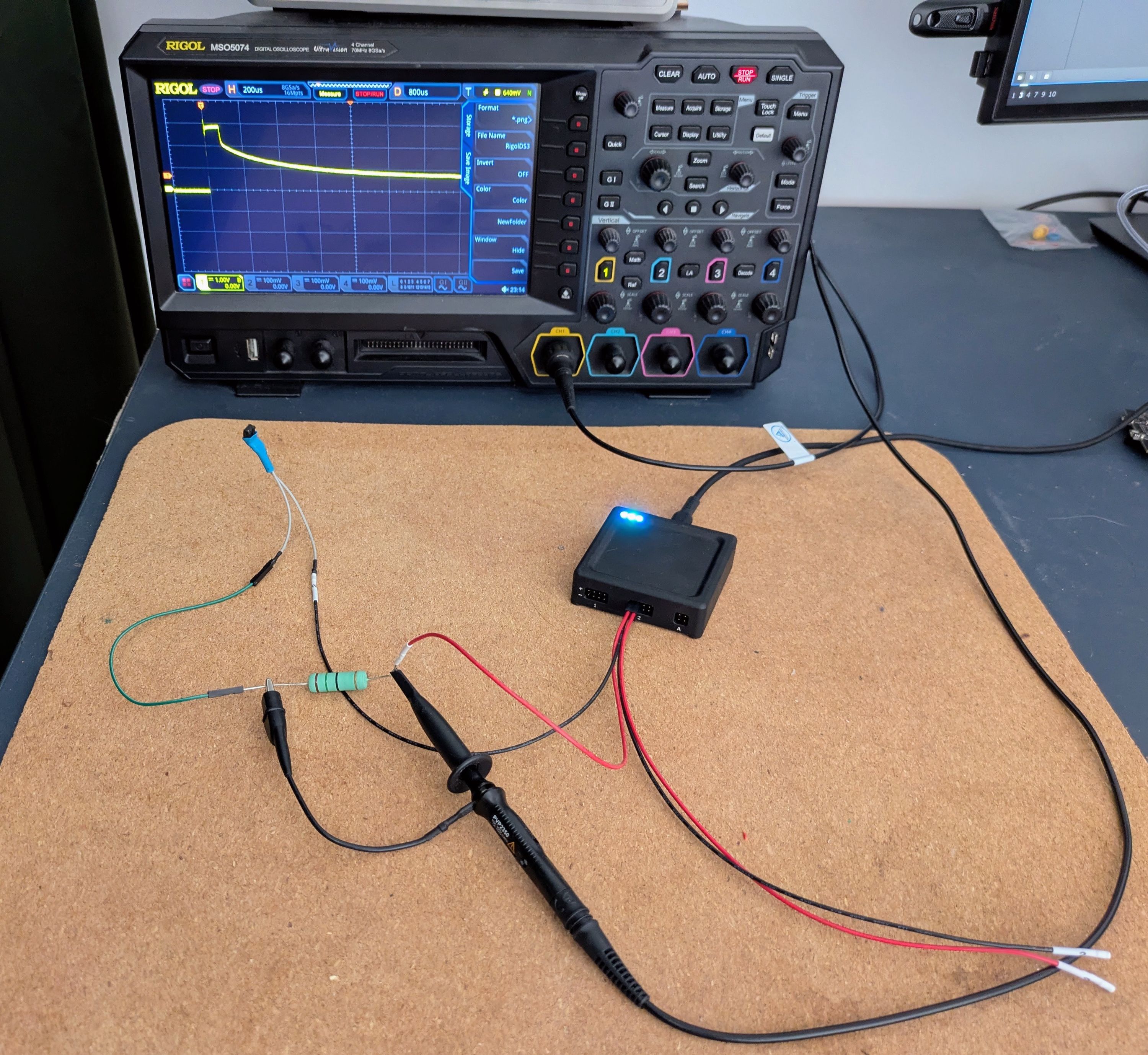
The Benchmark Setup
Let’s look at how current-limiting works on a commercial lab power supply first and then see how Ampisu compares. To test the reaction time, we used the following parameters for both power supplies:
- Load: 15 Ω resistor connected via a push button.
- Settings: 3.3 V output with a 50mA current limit.
- Measurement: Rigol MSO5074 oscilloscope recording the voltage across the resistor.
The Competitor: Siglent SPD3303X
We connect the resistor to the output of the Siglent SPD3303X power supply, enable the output, and press the pushbutton.
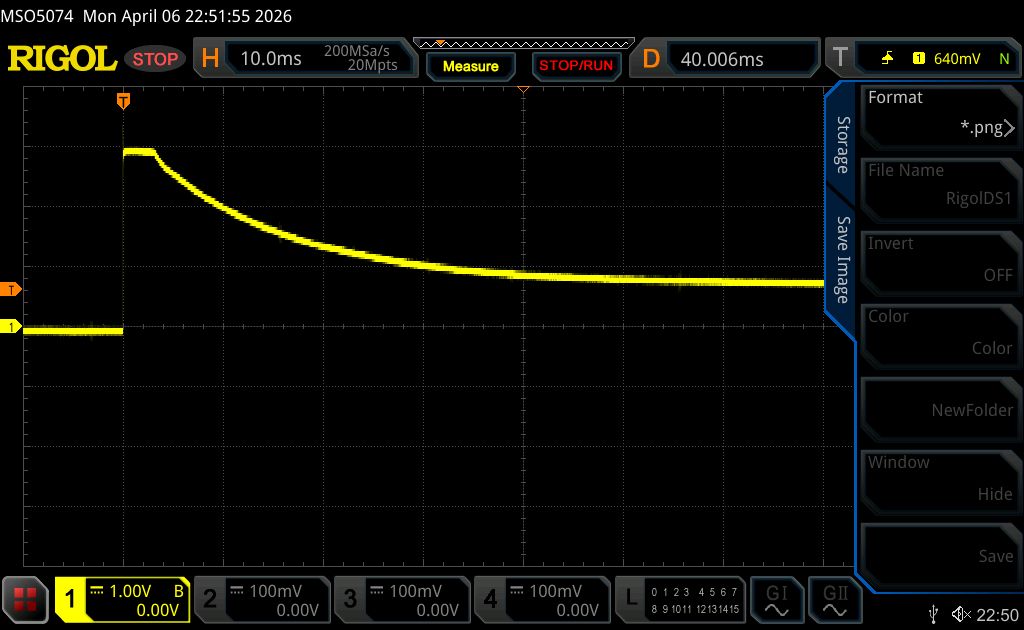
The oscilloscope shows the output jumping to roughly 3 V and lingering there for about three milliseconds before the current limit sets in. It then gradually reduces the voltage down to 750 mV within 60 milliseconds (which corresponds to the 50 mA current limit across a 15 Ω load).
The Challenger: Ampisu
Now let’s see how Ampisu performs in the exact same scenario. We configure one channel of Ampisu to 3.3 V with a 50 mA limit, then apply the resistor load.
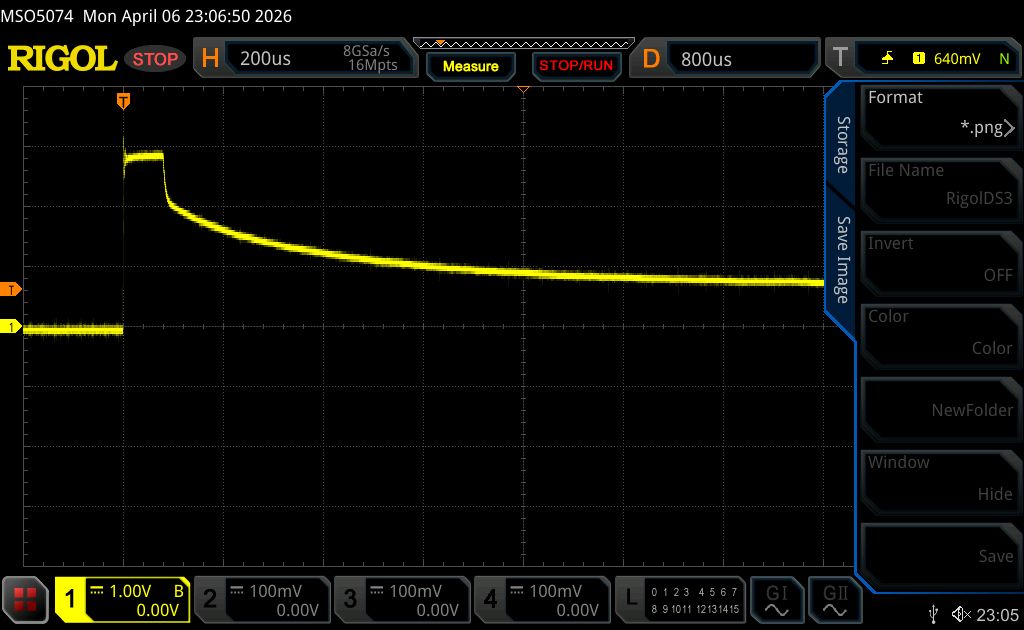
The output again quickly rises to around 3 V, but Ampisu’s current limit fully engages and starts rapidly pulling the voltage down after just 100 µs. After 1.4 milliseconds, the output cleanly settles to the final 750 mV target voltage.
Conclusion
Just like its bulky bench-top brothers, Ampisu’s current limit linearly reduces the voltage in order to respect the configured current limit. The direct comparison shows that Ampisu’s current limiting is 42x faster than its $591 (USD) competitor. This is mainly due to the big capacitors in the bench power supply that discharge into the load despite the current limit.
This little experiment proves that Ampisu is not just another USB gadget. It is a serious piece of lab equipment that you can rely on, whether you are at your desk or engineering on the go.
Reserve yours today
Our crowdfunding campaign is currently live. Reserve your unit today and help bring Ampisu to life!