Project update 4 of 6
Halfway There, Plus How We Beat the Heat
by Kai GWe’ve officially crossed the halfway mark of our campaign duration, and I am thrilled to share that we are already over 60% of our funding goal! A massive thank you to everyone who has backed and shared the project so far.
For this update, we are taking a deep dive under the hood to look at one of the most critical aspects of designing a pocket-sized power supply: Thermal Management.
The Challenge: Dissipating Nine Watts in the Palm of Your Hand
When you’re building a tiny power supply, heat is your biggest enemy. To put it in perspective, let’s look at a worst-case scenario: a short-circuit.
If Ampisu is short-circuited, the voltage drops, and the internal components have to absorb the brunt of the energy. Specifically, 4.5 W (500 mA * 9 V) is dissipated directly into the device per channel. For both channels, that is 9 W of pure heat being generated inside a device that fits in the palm of your hand! That might not sound like much, but it’s a massive number for such a small surface area.
To illustrate how we tackled this, we used a thermal camera to capture three distinct pictures to show you exactly how our thermal management works.
Thermal Image One: The Bare PCB
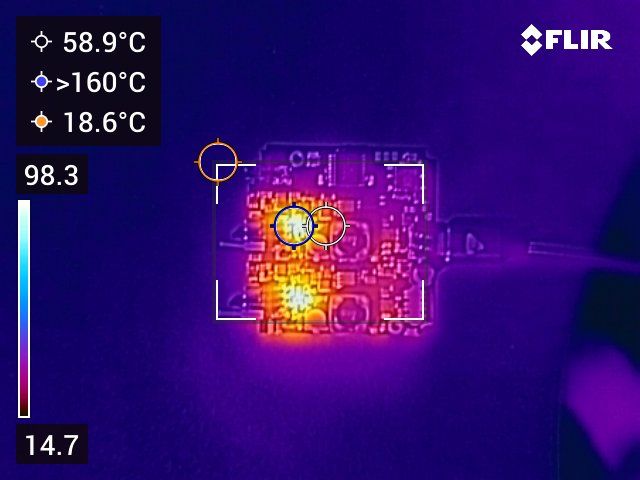
First, let’s look at what happens when we short-circuit both channels on the bare circuit board without any cooling. As you can see in the thermal image, within seconds, the heat generated around the MOSFETs in the current-limiting circuit spikes to over 160°C. That is dangerously hot and entirely unsustainable for operation.
Thermal Image Two: The Aluminum Enclosure
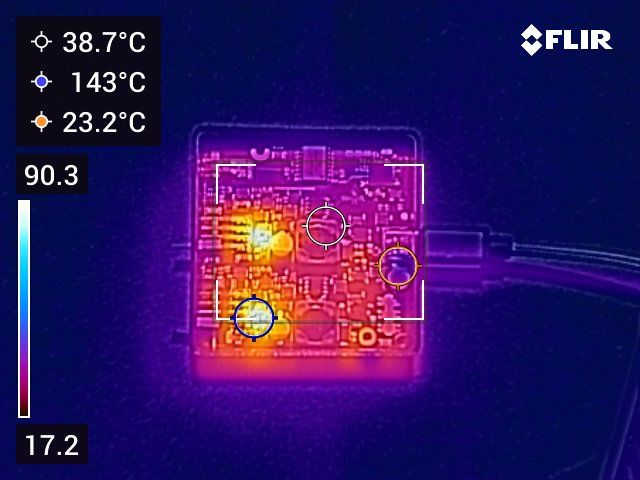
Next, we mounted the board inside our aluminum case using highly thermally conductive tape. We specifically designed the PCB with a massive array of thermal vias to pull the heat away from the surface pads, direct it to a large copper area on the bottom of the board, and transfer it straight into the aluminum case.
As the thermal image shows, the temperature dropped to 143°C. It’s a noticeable improvement, showing that the case is doing its job to pull heat away, but it is still much too hot for safe, sustainable use.
Thermal Image Three: Dynamic Pre-Regulation
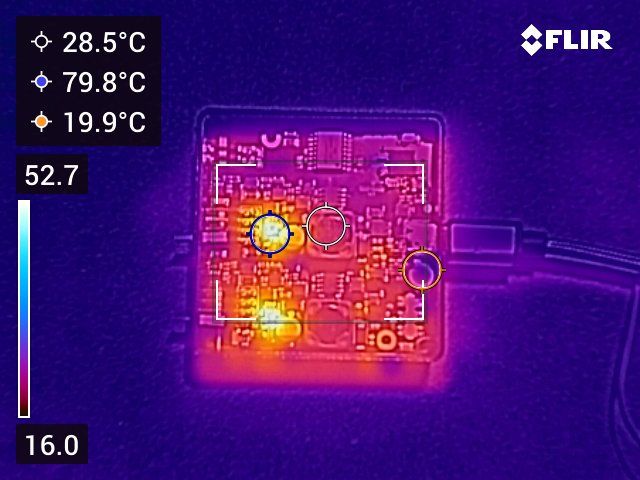
Hardware and enclosures alone weren’t enough, so we got smart with the control system. We introduced an additional DAC to dynamically regulate the output voltage of the Flyback DC/DC converter.
Instead of running the Flyback at the maximum 9 V all the time, the system adapts. If you select a 3.3 V output, the microcontroller automatically sets the Flyback to output 4.5 V instead of 9 V. Similarly, when the current is limited (like in our short-circuit test), the Flyback output voltage is dynamically reduced. By tightening that voltage gap, we drastically reduce the amount of power being dissipated as raw heat inside the device.
The result? Look at the final thermal image, above: a cool 79.8°C.
Full Transparency on the Trade-off: Because the microcontroller has to actively reconfigure the flyback voltage, there is a slightly slower response time when the load is suddenly decreased. However, this is a very minor tradeoff for a system that runs safely!
The Final Result
Ampisu’s performance relies on a three-part harmony:
- A thermally-optimized PCB design
- A heat-wicking aluminum enclosure
- Intelligent control via dynamic pre-regulation
This combination is what finally enables us to achieve linear regulation of significant output power inside an incredibly tiny form factor.
Want to experience this engineering firsthand? If you haven’t secured yours yet, support the campaign and place your order today! Let’s push past that funding goal together!