Project update 4 of 7
What We've Been Working On - Sharper Timing, Smarter Shakes
by Finch Yuan, Joshua LeeDear Wave Watchers,
While the campaign has been live, we’ve been anything but idle. Our team has been working tirelessly behind the scenes to make AnyShake more accurate, more stable, and more deserving of your trust.
In this week’s update, we’re excited to share our latest progress and achievements.
Precision Timing Matters, and We’ve Nailed It
For a seismic sensor, accurate timing isn’t a luxury, it’s essential. Even small errors in time-stamping can make waveforms useless for scientific analysis or network synchronization. That’s why we’ve spent the past few weeks addressing one of the hardest technical problems: time drift.
We started by using a GNSS module to provide a 1 PPS (one pulse per second) signal, a highly stable timing reference derived from satellite atomic clocks. But just having 1 PPS isn’t enough. The real challenge is making sure that AnyShake’s internal clock aligns perfectly with this external reference and stays aligned over time.
To do this, we developed a custom algorithm that works like a software-based phase-locked loop (PLL). Every second, AnyShake compares its internal timer against the incoming 1 PPS signal. It then calculates the frequency drift, in parts per million (ppm), and makes micro-adjustments to its system timer by tweaking the pre-scaler of the underlying hardware timer. To avoid disrupting the real-time operating system (RTOS) that powers the device, we even implemented a special technique to manually inject or suppress ticks so that timing remains smooth and stable.
The result? A frequency deviation of just ±0.1–0.2 ppm — matching the precision of much more expensive digitizers. That’s not just good, it’s scientific-instrument good.
And the best part? This level of performance is now available in our open-source device that’s affordable, accessible, and improving every day.
Timing Accuracy Comparison: AnyShake vs. Industry Standards
To validate the improvements we made to AnyShake’s timing accuracy, we conducted a direct comparison with two well-known seismic instruments:
- QUANTERRA Q330S (YGN1): a professional-grade, observatory-class digitizer used in national seismic networks worldwide.
- Raspberry Shake (R9164): a popular low-cost community seismograph widely used by hobbyists and educators.
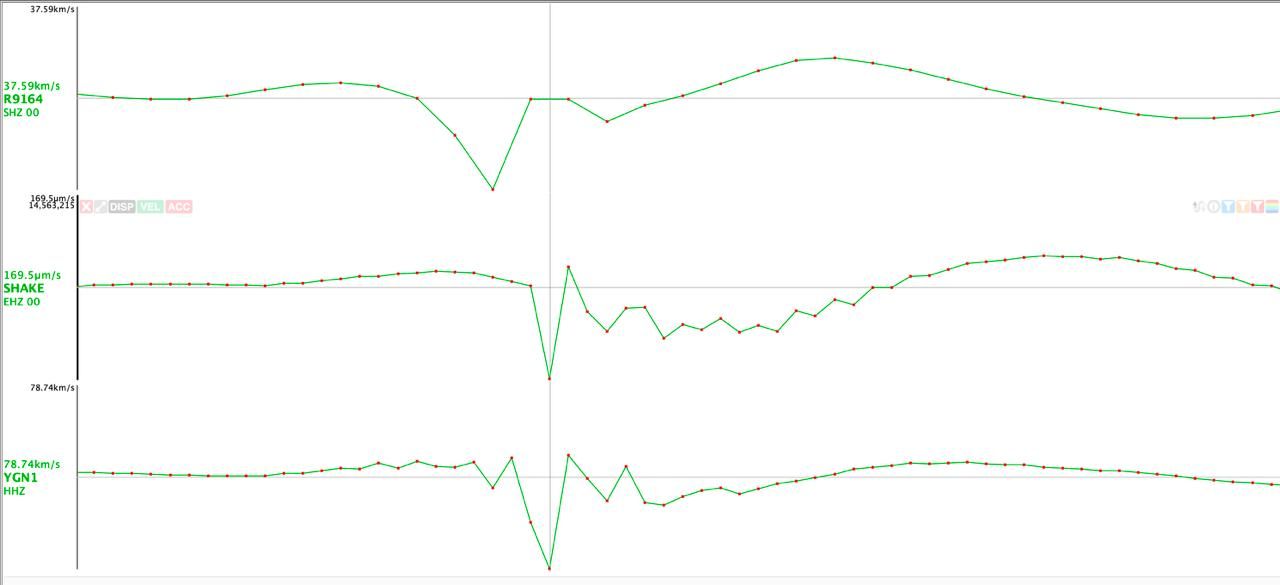
In the test, all devices were connected to GNSS with a 1 PPS signal and recorded simultaneous timestamps over an extended period. The chart below shows how the internal clocks of each device drift or align relative to true GNSS time.
The results speak for themselves:
- YGN1 (Q330S) maintains excellent time alignment, as expected from a high-end instrument.
- SHAKE (AnyShake) demonstrates near-identical time stability, with deviations well within ±1 millisecond, thanks to our custom, PLL-based clock calibration algorithm.
- R9164 (Raspberry Shake), while effective for general observation, shows more noticeable drift over time.
This comparison clearly shows that AnyShake has achieved professional-grade timing precision, rivaling equipment that costs several times more. And yet, it remains fully open-source, affordable, and easy to integrate into your personal or professional monitoring network.
In short, AnyShake can be your trusted choice. Whether you’re conducting research, building a sensor array, or just curious about the Earth’s vibrations, we’ve built a platform that combines real performance with real value.
Thank You for Believing in Us
Everything we do — from firmware updates to hardware tuning — is about making AnyShake better for you. We want you to know that we’re fully committed to this project, and we’re backing it up with strong technical expertise and responsive support. Whether you’re a researcher, a hobbyist, or just curious about the Earth beneath your feet, you can count on AnyShake.
If you’ve already joined us on this journey, thank you!
If you haven’t yet, now is a great time to join the movement.
Your support helps bring high-precision seismic sensing to more people around the world and we can’t wait to get AnyShake into your hands.
If you have any questions or just want to say hi, we’d love to hear from you.
Feel free to share our project with friends, colleagues, or anyone else who might be interested!
Warm regards,
The AnyShake Team