Aerio Solutions SAS
Test Equipment
Protocol Interfaces
USB Insight Hub
A USB interfacing tool for developers & tech enthusiasts
Aerio Solutions SAS
Test Equipment
Protocol Interfaces
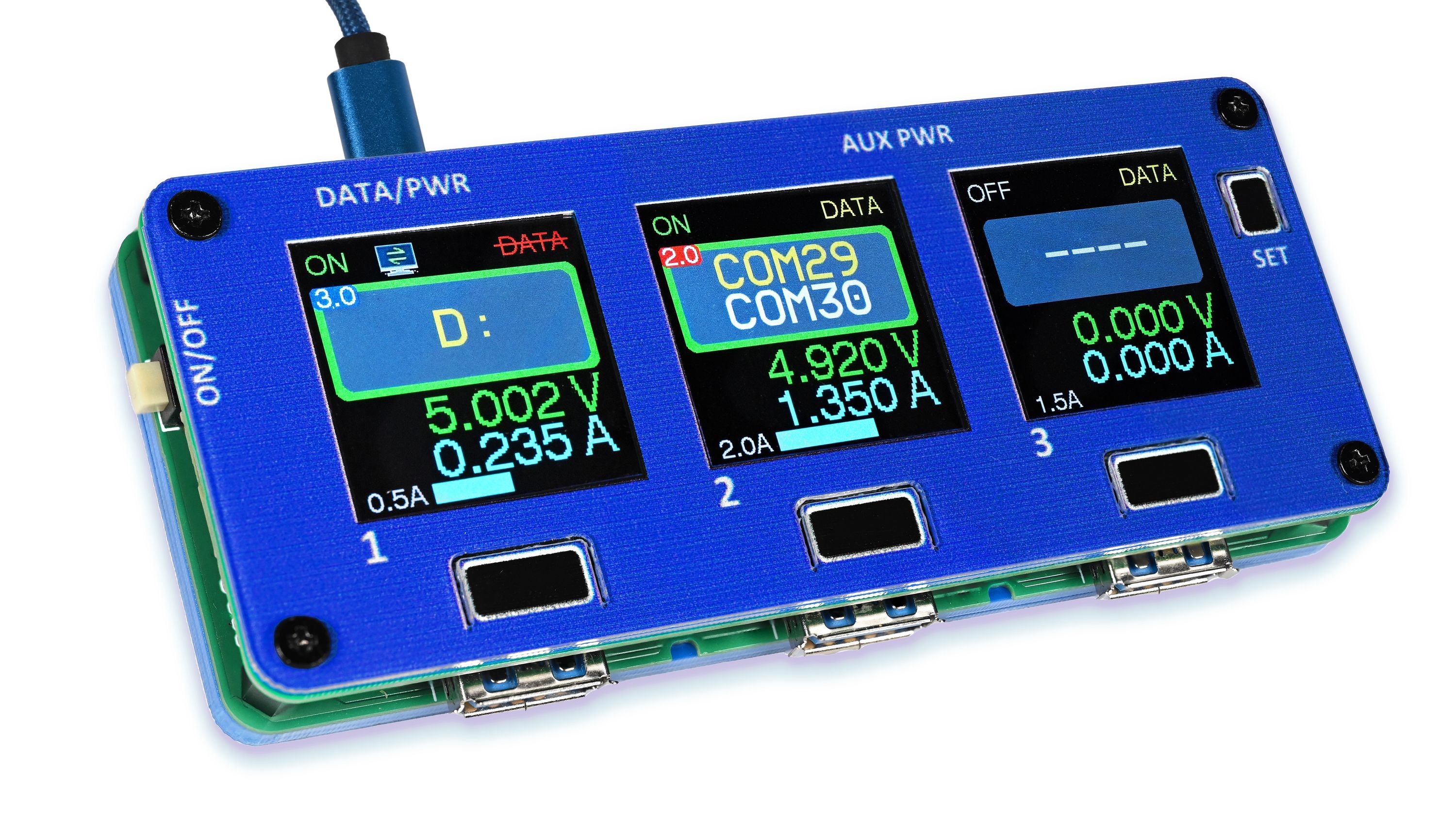
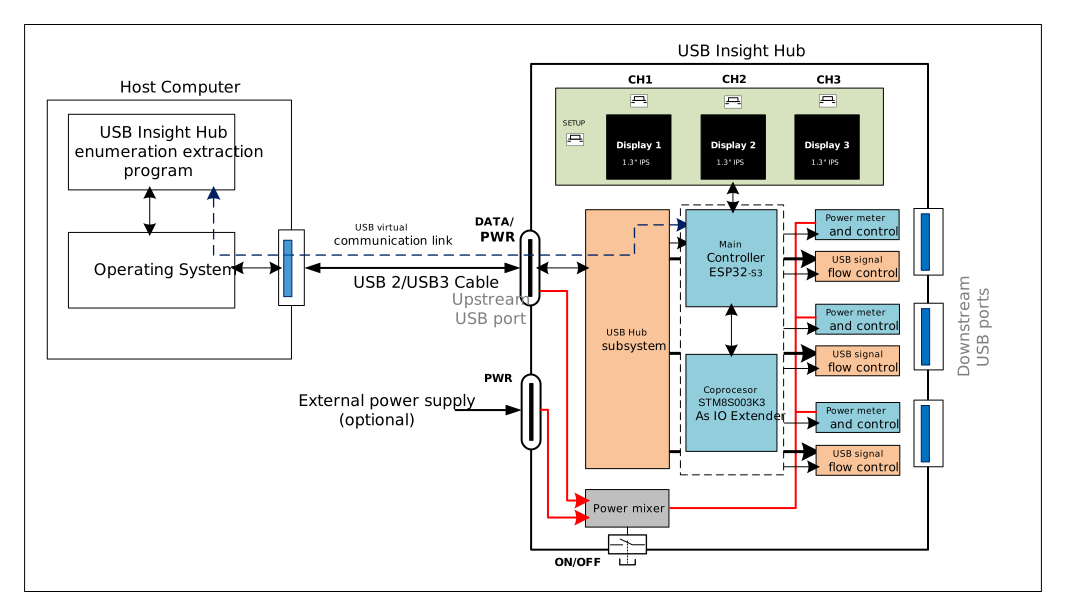
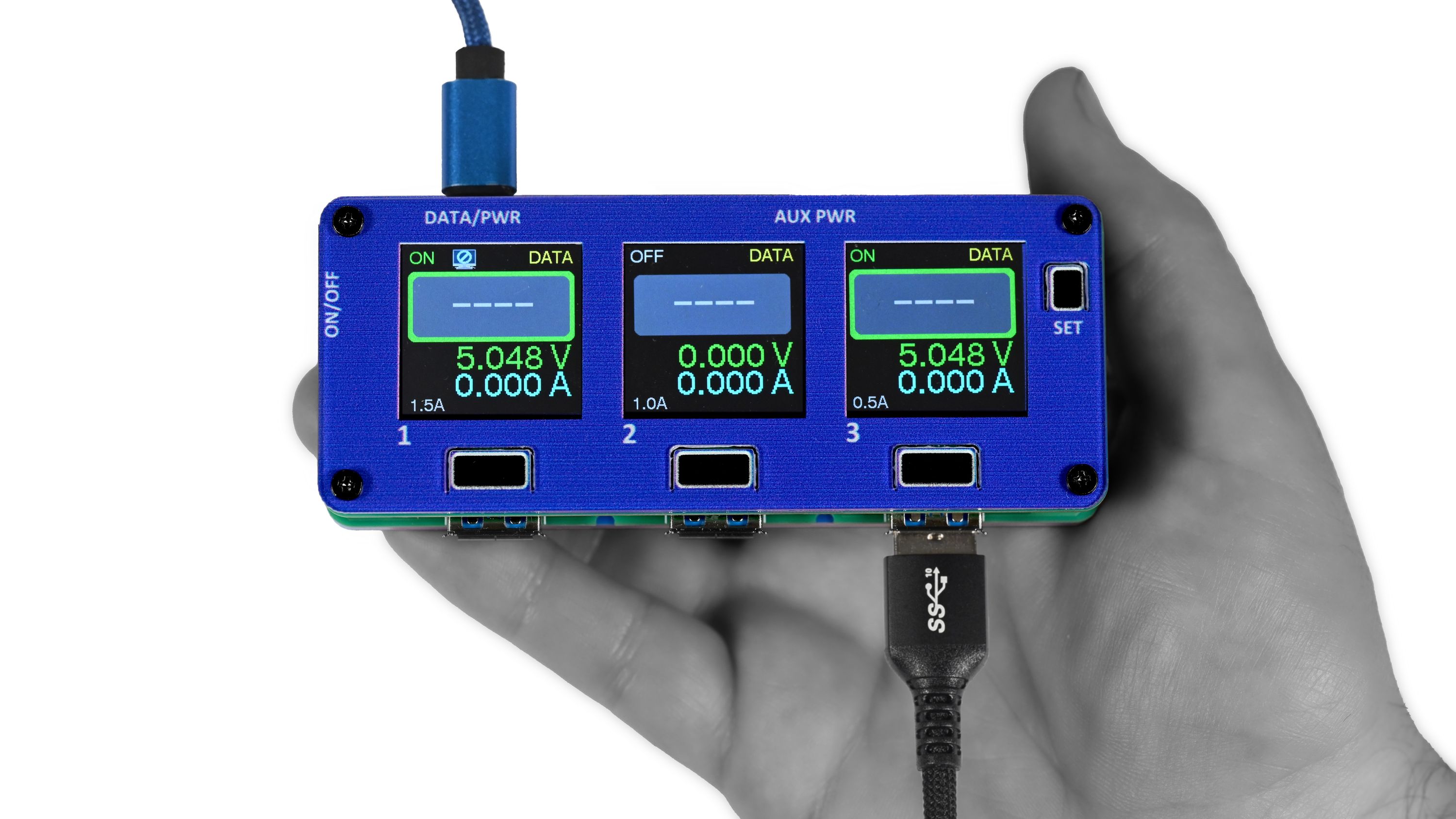
USB Insight Hub plugs into your computer through a USB Type-C connector and exposes three USB 3.0 downstream ports, each with a 1.3-inch screen that displays relevant information about the attached device. That information includes operating system enumeration name (COMx, TTYx, or drive letter), voltage, and current. USB Insight Hub also allows you to control the individual activation and deactivation of the D+/D- USB 2 data lines to force enumeration and control the power of each downstream device. A small application running on the host computer extracts USB information from the operating system and sends it to the Hub over USB.
You probably already have at least one USB hub on your desk or workbench. Bring that beloved peripheral into the modern era and improve your connectivity experience with USB Insight Hub.
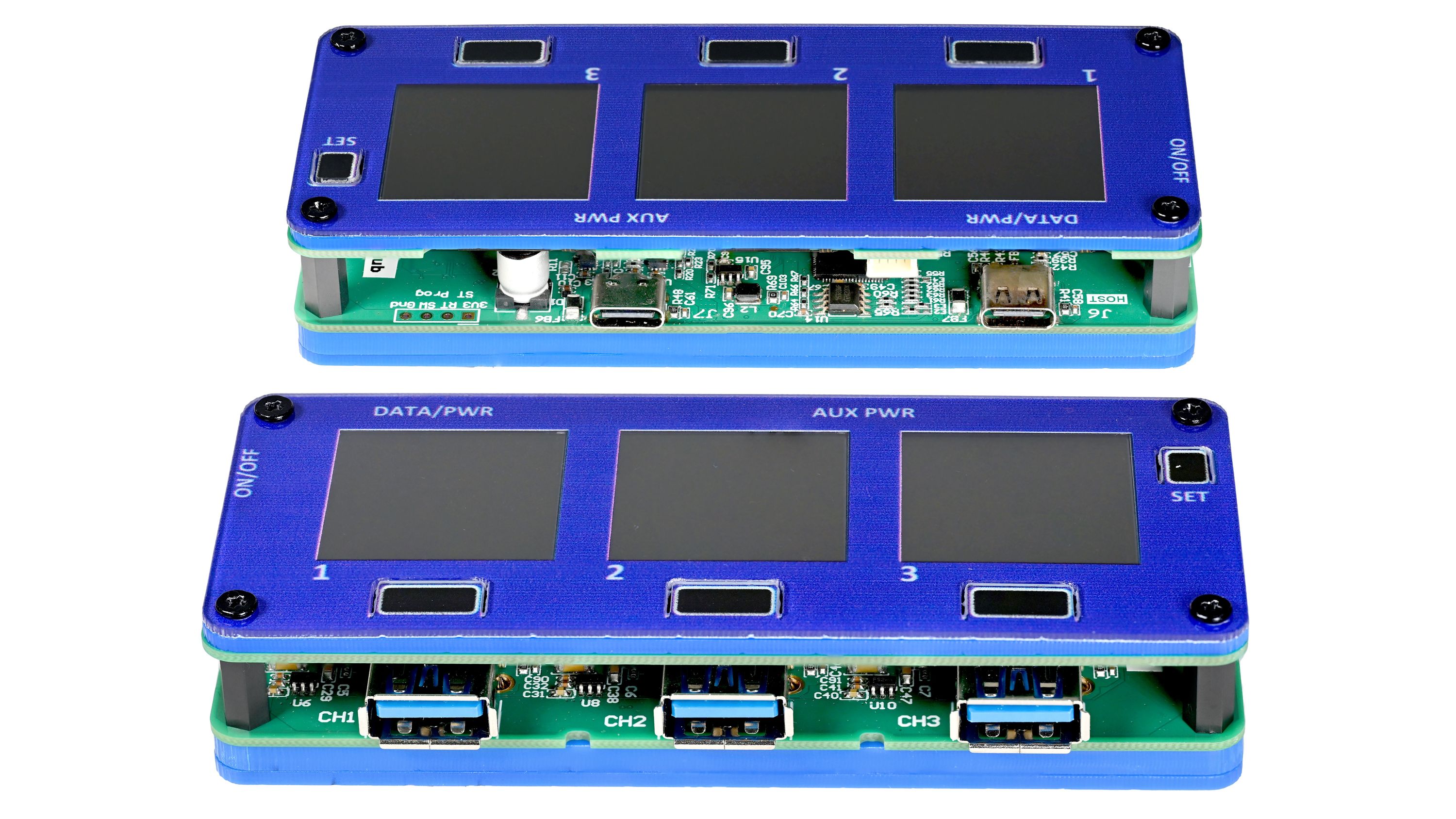
Plug and unplug your favorite USB development kit or tool. As you repeat this operation and change or add boards, your operating system assigns different enumeration names to the devices until, at some point, you lost track of which "virtual port" corresponds to which device. The same thing happens with virtual serial ports, USB flash drives, and other such peripherals. We’ve all been there, and we’ve all had to disconnect and reconnect one or more devices in order to refresh the enumeration. Which is just…no way to live.
With USB Insight Hub, our companion agent runs on your computer, extracts the enumeration data for each USB port, and sends it to be displayed on the corresponding screen so you can easily identify all of the virtual ports running through the Hub.
Each one of USB Insight Hub’s ports has a dedicated voltage and current meter that provide realtime feedback on your device behavior. This allows you to verify at a glance that everything is working normally or detect abnormal patterns on the fly.
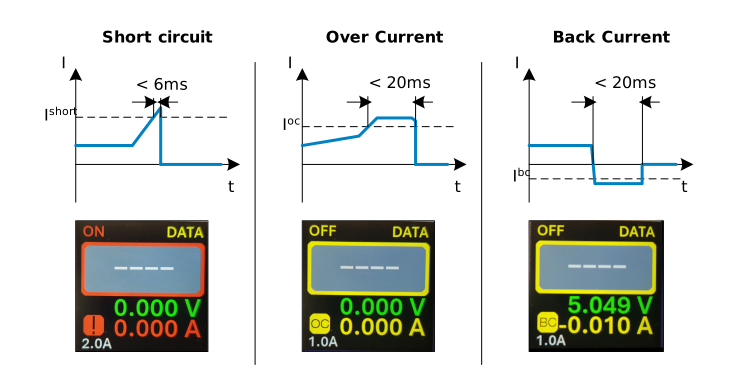
To avoid damaging your host computer and to handle downstream devices faults gracefully, USB Insight Hub implements three highly configurable protections for each port:
We love USB Hubs with independent power switches as they allow you to force a power cycle without having to unplug something and then plug it back in. USB Insight Hub provides a push button on each port that toggles power and a display that shows the current state.
It also features a USB-2 D+/D- switch on each port that toggles data connectivity on long press. Independent control of power and data is useful in a number of scenarios:
It is also possible to enable/disable the Super Speed communication lines of the Hub, effectively converting it in a regular USB 2.0 Hub if required.
USB Insight Hub also has a global power button, of course, but its ability to "stagger" the power-up sequence of connected devices allows for more predictable enumeration and more control over the initial power draw.
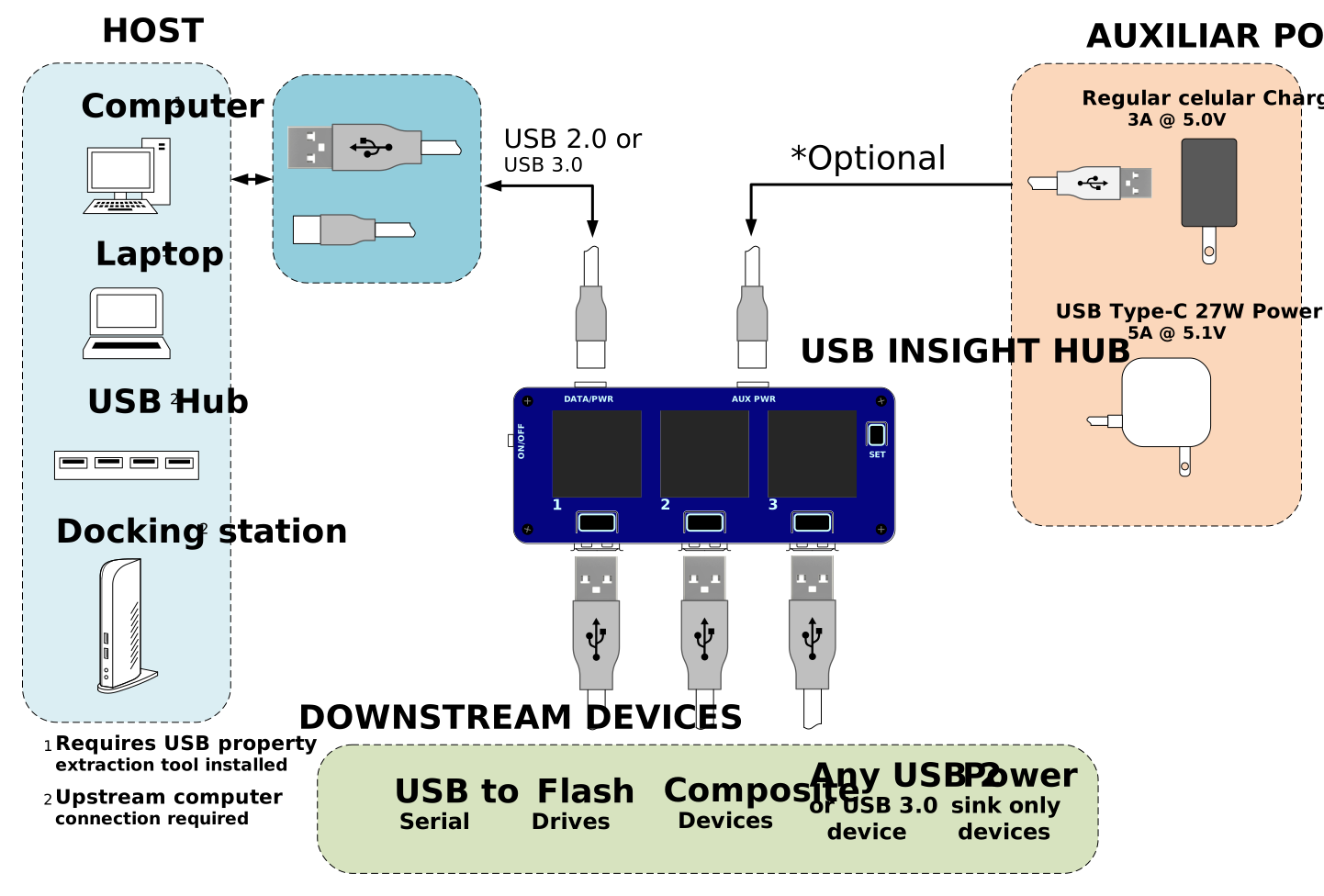
USB Type-C connectors are the new standard for interfacing to peripherals for reversible connectivity and improved power delivery. USB Insight Hub provides two USB Type-C ports for upstream connections:
The host and external power supplies are muxed together using special eFuses that reduce voltage drop in the power path and implement advanced over- and under-voltage protections, as well as inrush current control.
USB Insight Hub also includes a JST connector for STEMMA QT support to facilitate expansion opportunities involving sensors and actuators over I²C.
Finally, our downstream USB 3.0 Type-A ports are conveniently spaced 32 mm apart to accommodate larger devices and connectors.
USB Insight Hub’s 1.3-inch color displays allow for big, bright fonts that are easy to read from a considerable distance. You can rotate the content on those displays, as well, depending on your workshop setup.
Power and data buttons are mechanical, to provide better haptic feedback, and a setup button provides easy access to system configuration options.
USB Insight Hub’s ESP32-S3 can operate as an access point or as a Wi-Fi client and hosts a Web UI that mirrors the device’s physical displays and buttons. So, when the Hub itself is not physically accessible, you can use your browser to visualize its enumeration, current, voltage, and protection status. You can also control the power and data lines this way, which means you can remotely power cycle a device if you notice that it’s in a faulty state. The Web UI also provides a more convenient interface for certain advanced configurations.
It is possible to control USB Insight Hub directly by the serial connection of the host and the ESP32 using json strings. In this way it is possible to control power/data, read current /voltage and make changes in configuration. This is ideal for automation tasks in laboratory or test settings. This feature can’t be used alongside the Enumeration extraction agent (for the time being) as both require the same virtual serial connection.
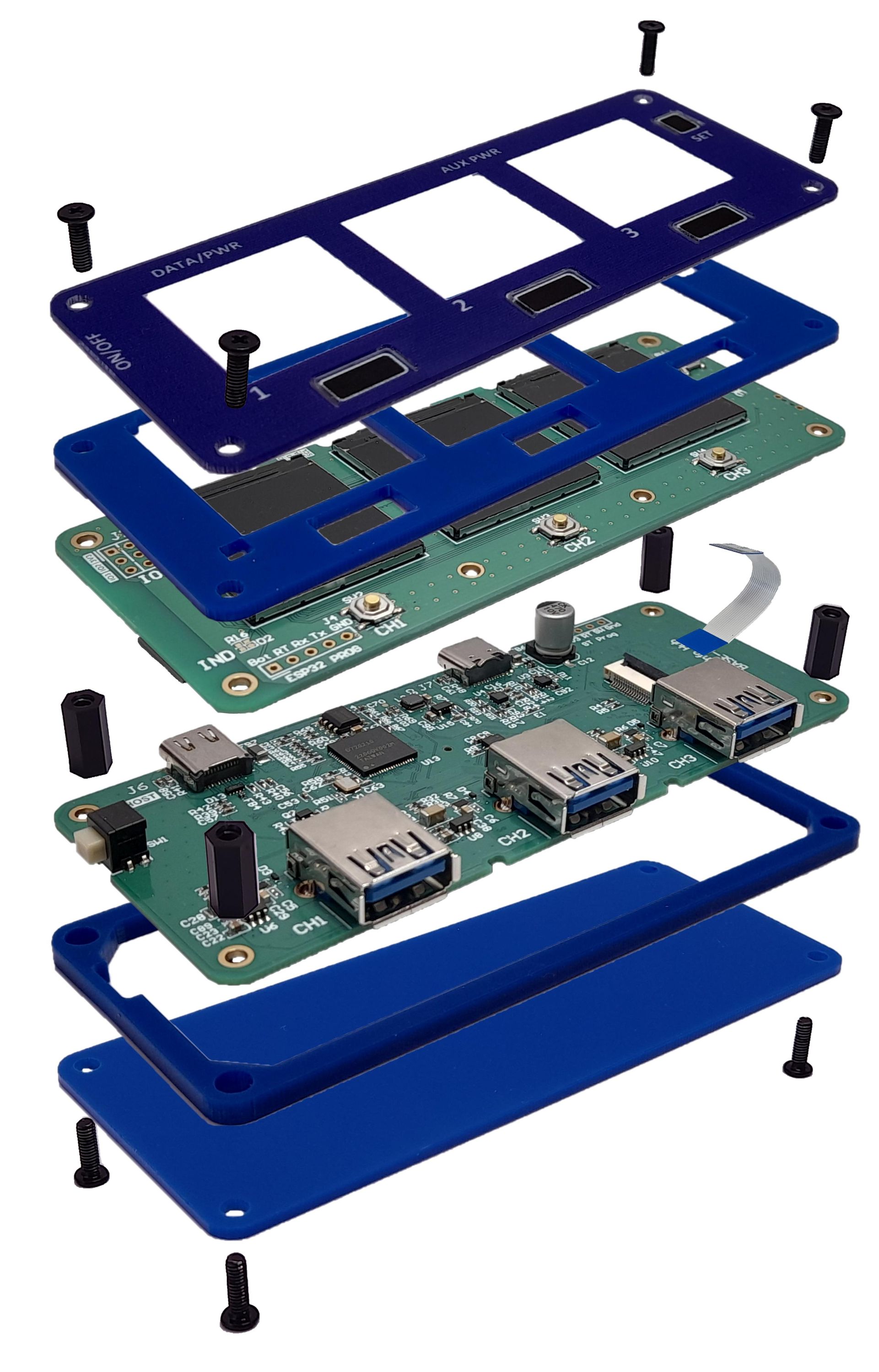
USB Insight Hub is composed of two PCBs interconnected by a flat flexible cable and vertically mounted using four standoffs, which are sandwiched between four acrylic pieces to provide a reasonable level of protection. The transparent acrylic faceplate hosts the art and cutouts for the buttons, but it also provides solid protection for the displays.
| USB Insight Hub | Programmable USB Hub | Acroname S77-USBHUB-2X4 | SABRENT 4 Port USB 3.0 Hub | USB Tester UM25C | |
|---|---|---|---|---|---|
| Input voltage | 5 V | 9 V to 25 V | 9 V to 24 V | 5 V | 4 V to 24 V |
| Power input connector | USB Type-C | Molex MiniFit Jr | DC Barreljack | DC Barreljack | None |
| Upstream ports | 1 | 1 | 2 | 1 | 1 |
| Upstream port type | USB Type-C | USB Mini B Flexconnect | USB Mini B Switchable | USB Type-A Pigtail | USB Type-C, Type-A, or Micro B |
| Downstream ports | 3 | 4 | 4 | 4 | 1 |
| Downstream port type | USB 3.0 Type-A | USB Type-A | USB Type-A | USB 3.0 Type-A | USB Type-C or Type-A |
| USB speed support | Low, Full, High, Super Speed 3.0 | Low, Full, High | Low, Full, High | Low, Full, High | Low, Full, High |
| Display | 3x 1.3-inch, high-contrast, IPS color (one per port) | 10x LEDs | 18x LEDs | 4x LEDs | 1x 1.44" Color |
| Buttons | 3x port controls, 1x setup | None | None | 4x power switches | 4x UI navigation controls |
| Global power switch | Yes | None | None | None | None |
| OS enumeration information | On display | None | None | None | None |
| Voltage & current monitoring | On display, API | API | API | None | On display, BT |
| Voltage & current resolution | 1 mV, 1 mA | 1.6 mV, 13.3 mA | 1.2 mV, 9.8 mA | None | 1 mV, 0.1 mA |
| Per-port power control | Port button, API | API | API | Switch | None |
| Per-port overcurrent control | Setup buttons, API | API | API | None | None |
| Per-port overcurrent limit | 0-2000 mA, 1 mA step | 500-2500 mA, 13.3 mA step | 500-2500 mA, 9.8 mA step | None | None |
| Per-port data killswitch | Port button, API | API | API | None | None |
| Connectors | STEMMA QT | Qwiic, mikroBUS, JST GH | None | None | None |
| Interfaces | I²C to STEMMA QT, 4x IO in PCB header | 1x UART, 2x I²C, 6x IOs, 1x ADC | None | None | None |
| Max current at 5 V | 5 A | 6 A | 10 A | 2.5 A | 5 A (pass through) |
| Per-port max current at 5V | 2 A | 2.5 A | 2.5 A | 2.5 A | N/A |
| Downstream charging protocols | SDP + CDP + DCP | SDP + CDP + DCP | SDP + CDP + DCP | SDP + CDP + DCP | SDP + CDP + DCP + Other |
| Dimensions | 110 x 45 x 21 mm | 108 x 88 x 30 mm | 86 x 97 x 28 mm | 87 x 37x 13 mm | 71 x 31 x 12 mm |
| Spacing between ports | 32 mm (horizontal) | 30 mm (vertical) | 9 mm (vertical) | 13 mm (horizontal) | N/A |
USB Insight Hub is open sourced and you can check for the relevant information in our Github repositories:
If you have questions or suggestions, please reach out using the "ask a question" link on our page. We look forward to hearing from you!




Produced by Aerio Solutions SAS in Quito, Ecuador.
Sold and shipped by Crowd Supply.
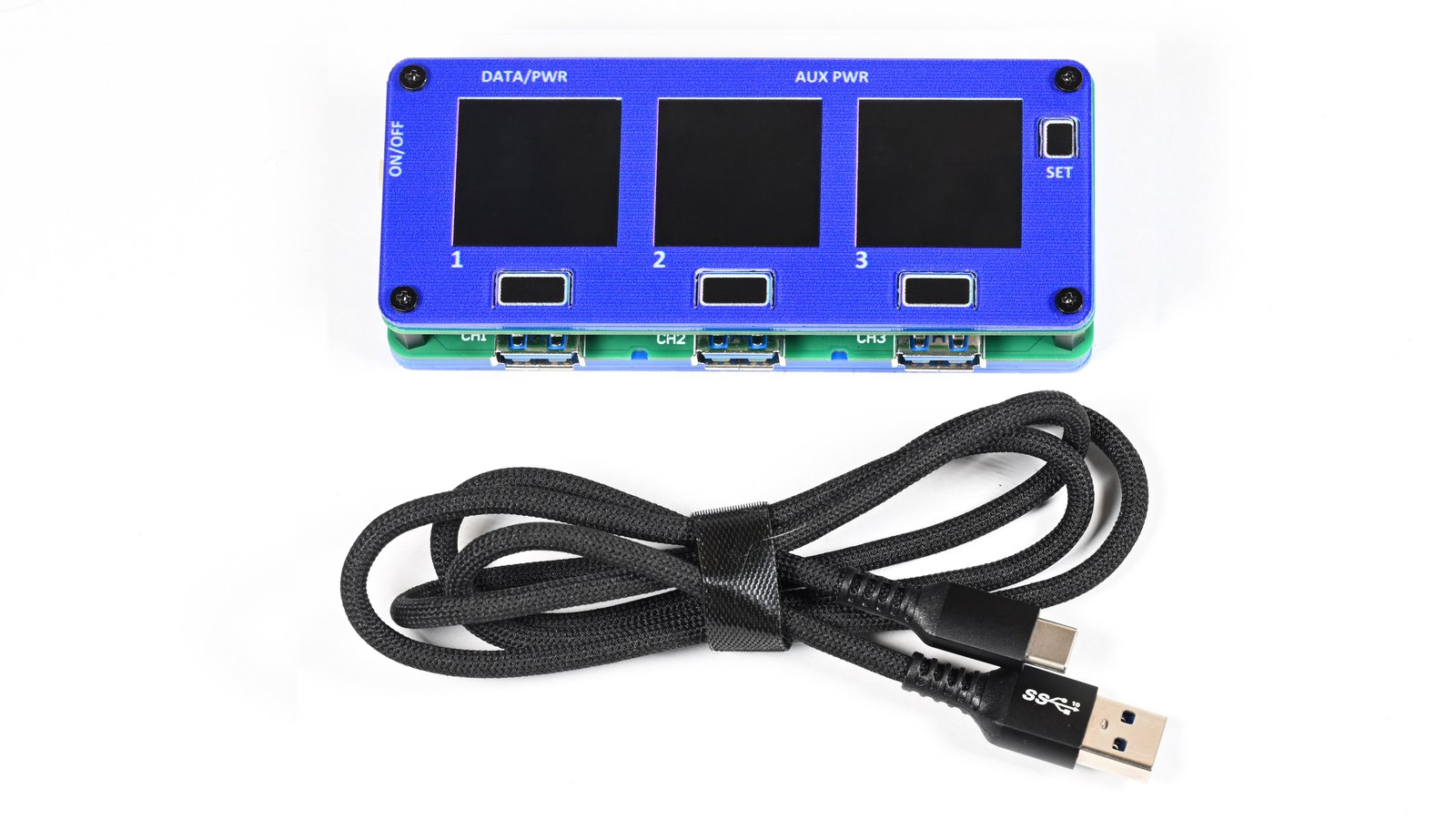
USB Insight Hub with an acrylic enclosure. Includes a 1-meter USB Type-A to Type-C cable

· usbinsighthub.com · aeriosolutions · aeriosolutions · aerio-solutions · aeriosolutions
We make tools and wireless accessories for IoT devices