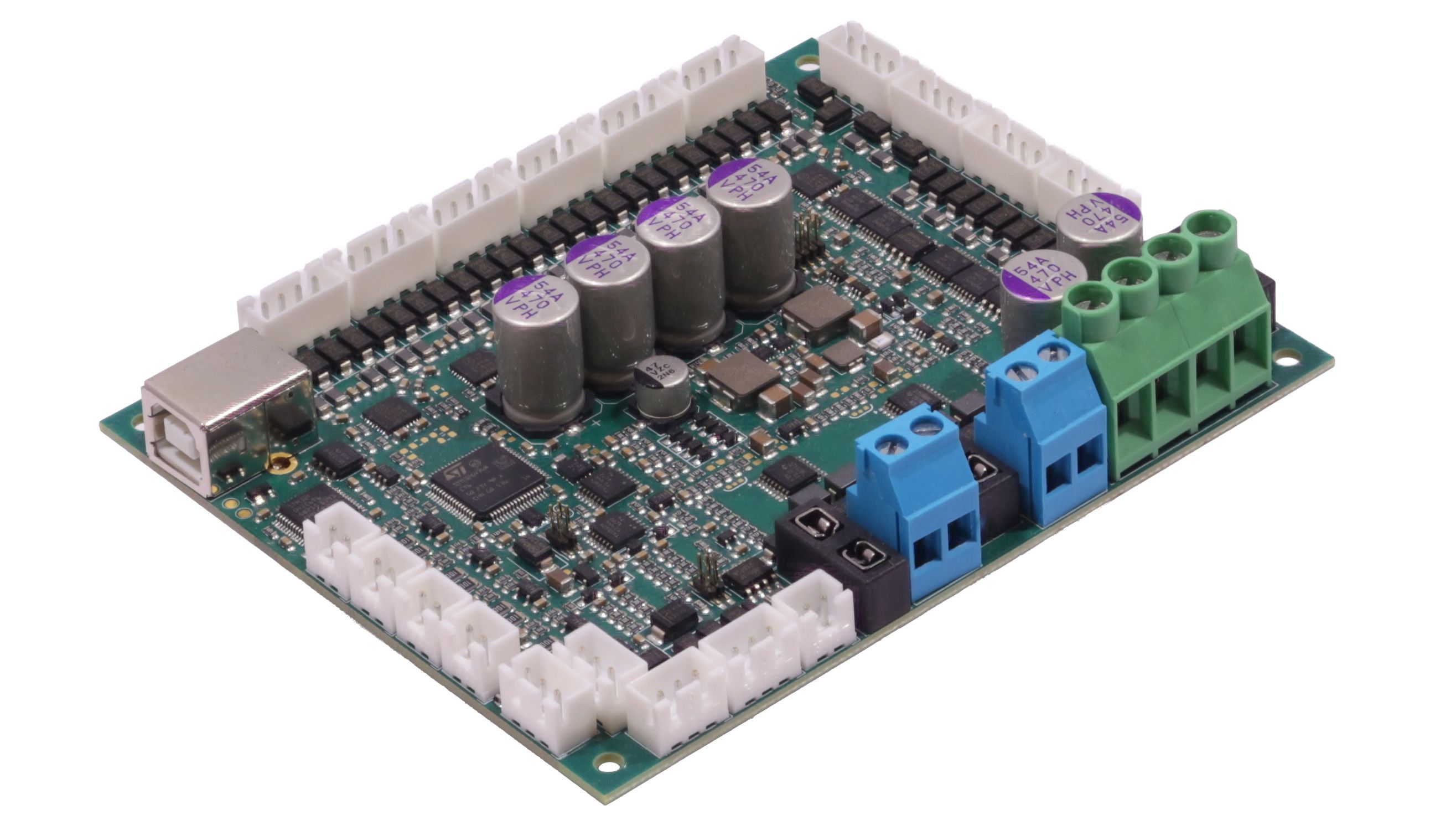
Prunt Board 3 is a 3D printer control board designed for enthusiasts who want performance levels their printer is capable of, but that existing motion controllers won’t let them reach.
This is the first widely available hardware to run Prunt motion controller, our completely new motion control system. Both hardware and software include features you won’t find anywhere else, helping make your 3D printer faster, safer, and capable of higher-quality prints.
Most popular 3D printer motion controllers (Klipper, Marlin, RepRapFirmware) top out at 3-phase G¹ tangential motion profiles: a trapezoidal velocity curve where acceleration is always either zero or the maximum allowed value. The problem is that real-world objects simply cannot change acceleration instantaneously. Forcing 3D printer motors to try results in vibrations, ringing artifacts in prints, and accelerated wear on components.
Some commercial and niche open-source controllers step things up with a trapezoidal acceleration curve, a 7-phase "s-curve," which is meaningfully better but still describes motion that isn’t physically possible.
Prunt Board 3 goes two steps further. By making the 4th derivative of acceleration a rectangular wave, we arrive at a 31-phase velocity profile with significantly smoother motion. To make this concrete, we’ve plotted velocity and its first 4 derivatives for both 3-phase and 31-phase profiles. Every plot was generated in Prunt motion controller itself, because Prunt lets you set tangential limits for each derivative individually, meaning you can emulate other controllers by tweaking a few parameters in the GUI.
One note worth making: Marlin does support some higher-order profiles, but they don’t allow individual adjustment of derivative limits, and they’re made less useful by the absence of advanced corner blending, covered next.
If you’ve dug into Klipper or Marlin’s advanced settings, you know that both take corners at non-zero tangential velocity to keep print times reasonable. Stopping at every corner would be painfully slow. But this introduces a brief period of infinite axial acceleration at every corner, which largely undoes the benefit of smooth tangential velocity profiles.
Prunt motion controller solves this with a degree-15 Bézier curve built directly into the control system. No special slicer required. And it’s a more complete solution than arc blending, which only smooths axial acceleration while the higher derivatives still see instantaneous changes when entering or leaving an arc. It’s also worth noting that both Marlin and Klipper chop arcs into coarse line segments, which reduces their usefulness for smooth motion anyway.
Rather than walk through the math, we’ll let the plots speak for themselves.
The combination of Prunt’s motion profiles and corner blending also makes for significantly quieter printing compared to Klipper. The video below uses real slicer output: the same g-code runs on both systems with identical kinematic parameters, with extrusion and heating disabled so fans are off and only motion noise is captured.
Every component on Prunt Board 3 is selected to exceed its requirements, sourced from established manufacturers with thorough parametrization. No poorly characterized substitutes, which means every board works reliably under all conditions.
One of the most consequential choices: 2820 µF of high-quality hybrid polymer bulk capacitance. That’s more than 5 times the bulk capacitance and 10 times lower ESR than a Duet 3 Mini 5+ or BTT SKR 3. Our capacitors are also rated for longer lifetimes at higher temperatures. The goal is a board that outlasts most of what’s on the market, and this is one of the things that gets us there.
Klipper and Marlin both rely entirely on software for step signal timing. This works, until it doesn’t. Software is doing many things at once, and step generation has to compete for CPU time. This is one root cause of the "timer too close" errors in Klipper that have hundreds of reports online. You may have hit one yourself.
Prunt Board 3 offloads all step generation to hardware timers, producing step and direction signals referenced to a 1.2 GHz master clock. Heaters, fan PWM outputs, and thermistor oversampling are also hardware-offloaded, enabling high output and sampling rates without any additional CPU load and ensuring correct behavior across all parameter combinations.
Prunt Board 3 is also the most robust 3D printing control board on the market. Short a heater wire, and the board detects it and shuts off heater power within 2 microseconds. Short a thermistor to a heater: no damage, and the board reports it. Short a fan wire: same story. If something catastrophic happens to the board itself, the isolated USB port means your PC or Raspberry Pi stays protected.
These aren’t edge-case features. Below is a detailed breakdown of each protection and how it compares to what other boards offer.
On nearly every 3D printer board on the market, a short-circuited heater output is handled by a single fuse, or worse, a fuse shared across multiple outputs. A fuse will usually prevent a fire, but it won’t save your board: fuses take anywhere from milliseconds to minutes to blow, depending on overload magnitude, while a MOSFET can be destroyed in microseconds.
A simple wiring mistake or a melted wire can turn an expensive board into e-waste. Prunt Board 3 uses a smart high-side switch on each heater output, capable of rapidly limiting the current and then switching off the output in the event of a short. Fast detection alone still wouldn’t protect the MOSFET against a dead short, so each output also includes a large inductor to limit current slew rate until the active protection kicks in. The result: a 5 A fuse on the heater output doesn’t even warm up before the output is already off.
Current sensing on heater outputs also enables detection of abnormal conditions that won’t damage the board but may indicate a failing printer component, catching problems before they become bigger ones.
Fan outputs are typically more vulnerable than heater outputs: smaller MOSFETs, no per-fan fuses, and the same risk of short-circuit damage. Prunt Board 3 gives each of its 4 fan outputs a dedicated low-side and high-side switch, and every switch is self-protected against over-current and over-temperature. The high-side switches report status back to the MCU, so you know immediately when something’s wrong.
Thermistors sit close to heaters and bare wires, making them easy to short to 24 V. Most boards either skip protection entirely or implement it in a way that fails when it matters most.
The standard approach (connecting the positive pin directly to the MCU) destroys the MCU during a 24 V short. A few boards (Duet 3 Mini 5+, BTT SKR 3) use a series resistor with clamping diodes, which helps but still injects current into the MCU outside its functional ratings, and the series resistor limits oversampling speed. Prunt Board 3 uses a correctly sized resistor combined with an op-amp buffer rated to handle current injection, keeping all components within functional specifications and allowing fast oversampling.
On the negative pin, most boards connect directly to ground, meaning something melts before anything trips. The Duet 3 Mini 5+ adds a self-resetting fuse, which is better, though the MCU is still exposed to out-of-spec current injection. Prunt Board 3 adds the self-resetting fuse and the circuitry needed to fully avoid MCU current injection.
To illustrate what poor protection actually looks like, here’s a BTT SKR 3 thermistor input shorted to a heater wire. The SKR 3 is notable for this: shorting the low pin of a thermistor turns on all heaters on the board. It also markets its thermistor inputs as "protected to prevent MCU damage," so you can see the gap between the claim and reality.
3D printers are full of plastic parts rubbing against each other (wire insulation, cable chains), constantly generating static charges that eventually find their way back to the control board. Most boards add no ESD protection at all, or protect only the stepper driver outputs with output capacitors. The result is a steady stream of failed stepper drivers and dead MCU pins that’s far too common to be a coincidence.
Prunt Board 3 has properly designed ESD protection on every pin: large transient voltage suppression diodes and current-limiting elements on all connectors. A small series resistor without TVS diodes, which many vendors appear to believe constitutes protection, does nothing useful against most ESD events. High voltage simply jumps across it.
| Prunt Board 3 | Duet 3 Mini 5+ | BTT SKR 3 EZ + 5× EX2209 | |
|---|---|---|---|
| Stepper Drivers | 6× TMC2240 | 5× TMC2209 | 5× TMC2209 |
| Step Signal Generation | Hardware or software | Software only | Software only |
| Heater Outputs | 2× 12 A | 12 A, 2× 5 A | 10 A, 2× 5 A |
| Heater OCP | 1.3 µs response time OCP | Fuse only | Fuse only |
| High-Side Fan Outputs | 4× 2 A (selectable low or high) | None | None |
| Low-Side Fan Outputs | 4× 1.7 A (selectable low or high) | 4× 2 A | 3× 1 A |
| Fan Output OCP | Individual current limit per output | Shared fuse | Shared fuse |
| Tachometer Inputs | 4× | 2× | None |
| Tachometer Input OVP | Within operational ratings | Within stress ratings only | N/A |
| Endstop Inputs | 4× | 6× | 6× |
| Endstop Input OVP | Fully protected | Stress ratings only | Damage likely at 24V |
| Endstop Power OVP | Diode protection | Diode protection | No protection |
| Endstop Power Rail | Dedicated rail | Shared with MCU | Shared with MCU |
| Thermistor Inputs | 4× buffered | 4× unbuffered | 3× unbuffered |
| Thermistor Input OVP | Protected on both pins | 3× overloaded resistors | Low pin unprotected |
| USB Isolation | Yes | No, Ethernet protected | No |
| ESD protection | On every pin | Minimal | None |
| Bulk Capacitance | 2820 µF | 500 µF | 500 µF |
| Price | $190 | $150 | $90 |
| Prunt | Klipper | Marlin | |
|---|---|---|---|
| Motion Profiles | 31-phase w/ adjustable derivatives | 3-phase | 3-phase, optional S-curve |
| Corner Profiles | Degree-15 Bézier curves | Infinite acceleration | Infinite acceleration |
| Pin Mappings | Vendor-provided | User-defined | Vendor-provided |
| Configuration Interface | Web GUI + built-in docs | Text files | C++ header files |
| Failsafe A/B Firmware Updates | Yes | No | No |
| Separate Server Host Required | Yes | Yes | No |
| Delta Kinematics Support | Not yet supported | Yes | Yes |
| Hardware-Accelerated Step Gen. | Yes | No | No |
Documentation, including a getting started guide and schematics, is available on our website.
Feel free to ask questions on our Discord or contact us using the Ask a technical question button near the bottom of this page.
Elecrow will handle PCB production and assembly. They provide more flexibility than other low-cost services while still maintaining a competitive price. Working with Elecrow allows us to customize the finer details of our PCB and assembly processes to deliver the best hardware possible. After assembly, the PCBAs will be shipped to us in Australia, where we will fully inspect and test every board.
We’ll send the assembled Prunt Board 3 boards to Crowd Supply’s fulfillment partner, Mouser Electronics, who will handle distribution to all backers. You can learn more about Crowd Supply’s fulfillment service under Ordering, Paying, and Shipping in their guide.
Components have been selected to be substitutable wherever possible in case of shortages. There are a few components on the board that can not easily be substituted; however, these all come from large manufacturers with stable supply chains.
Prunt Board 3 is part of Elecrow Project Aviary



Produced by Prunt 3D in Perth, West Australia.
Sold and shipped by Crowd Supply.
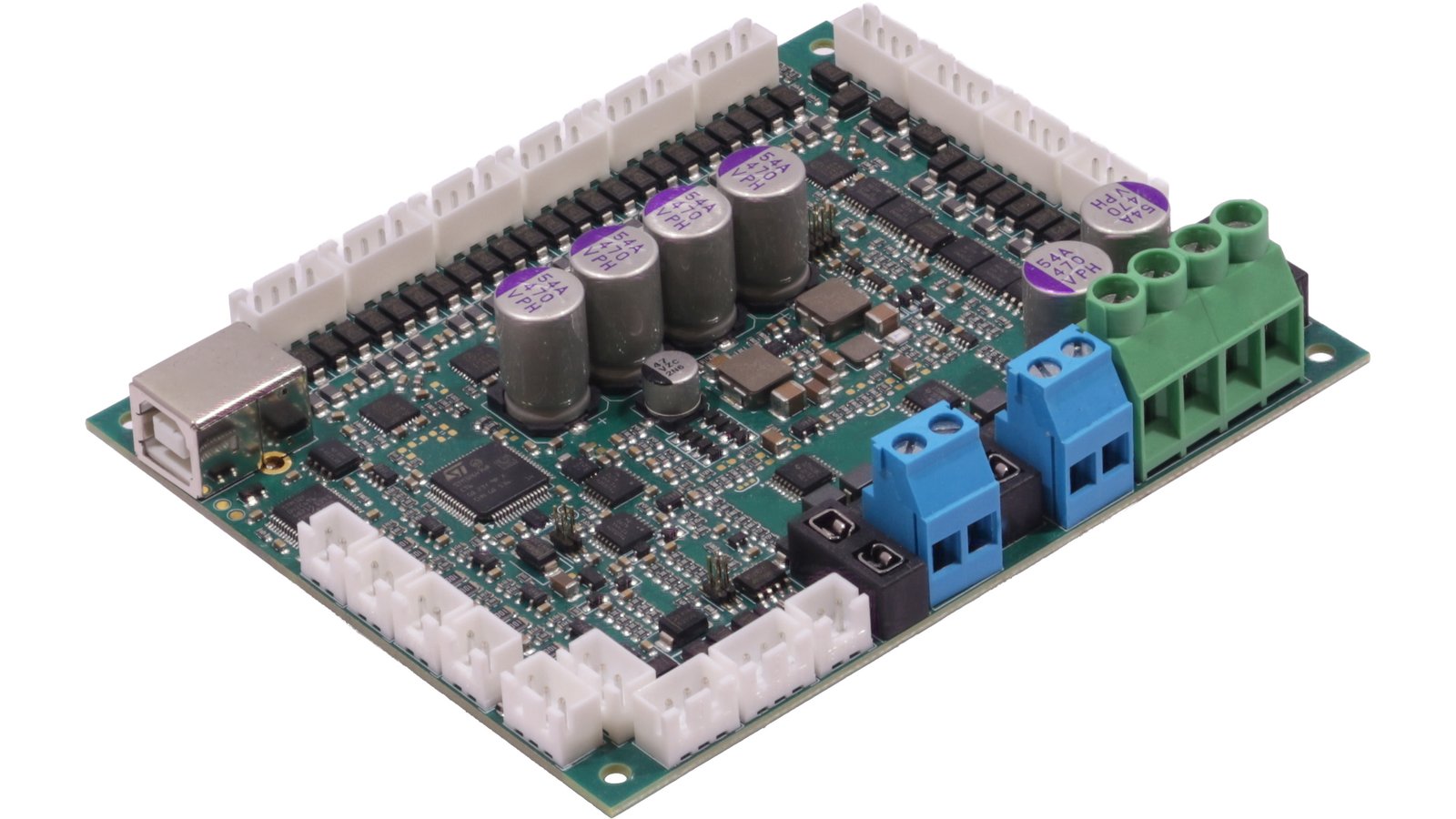
Prunt Board 3 board. Cables not included.